
A Major Milestone in Carbon Removal
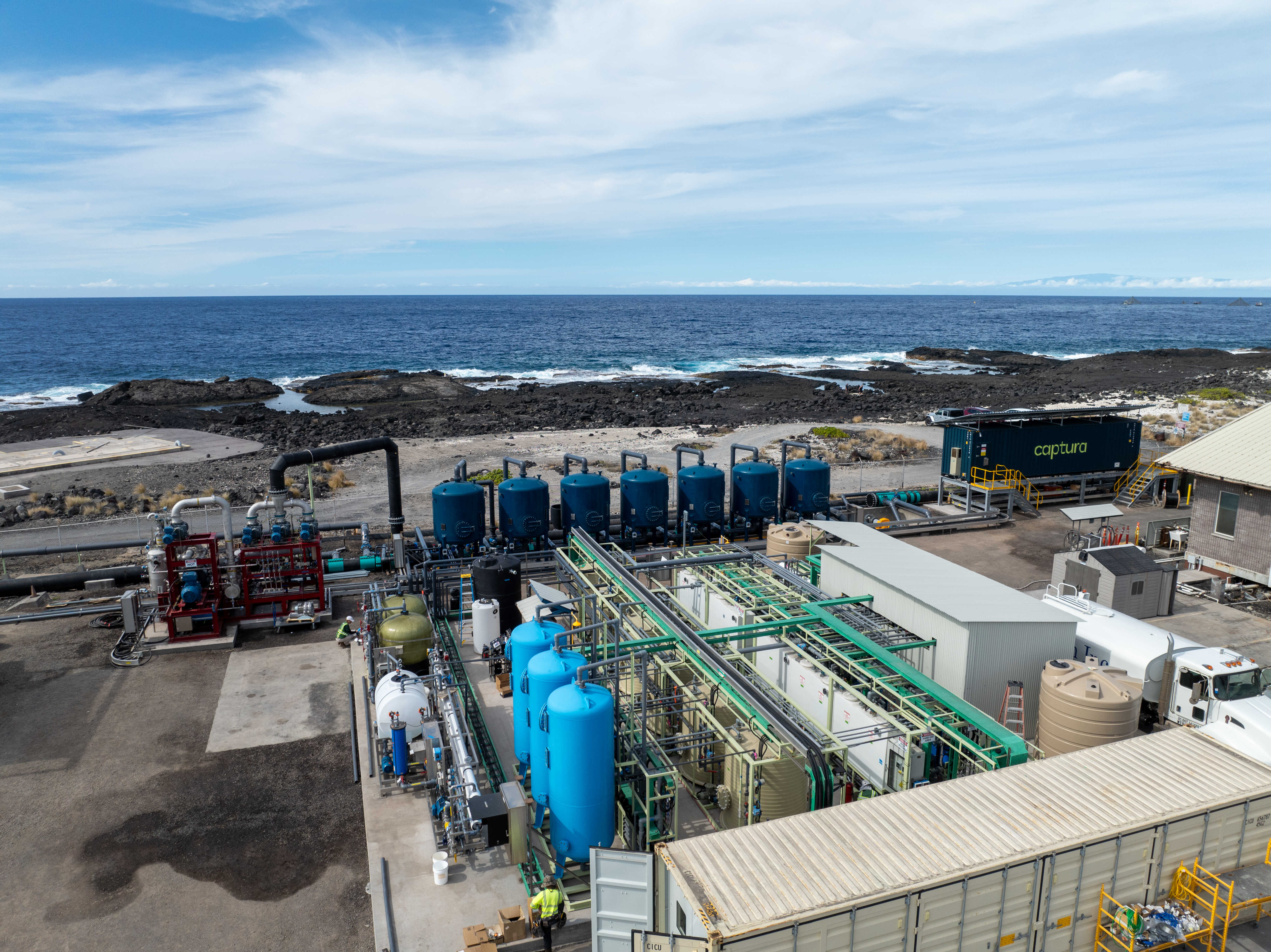
Captura has officially launched operations at its newest Direct Ocean Capture (DOC) pilot plant in Kona, Hawaii. The plant, developed in collaboration with energy giant Equinor, is designed to capture 1,000 tons of CO₂ annually—a significant advancement in scaling DOC technology.
This marks the third and final pilot project in Captura’s technology development program, pushing the company closer to deploying large-scale commercial systems worldwide. The goal? To leverage the ocean’s natural carbon-absorbing abilities to extract excess CO₂ from the atmosphere and help fight climate change at a meaningful scale.
>> RELATED: Direct-ocean Carbon-capture Pilot Plant Starts Up in Hawaii
How Direct Ocean Capture Works
The ocean absorbs roughly 30% of global CO₂ emissions, making it one of the planet’s largest carbon sinks. Captura’s DOC technology extracts CO₂ directly from seawater, which enhances the ocean’s ability to pull even more CO₂ from the air. This process is scalable and efficient because it:
- Uses natural oceanic processes with no need for feedstock.
- Produces zero waste or harmful by-products.
- Relies on widely available water and gas handling systems.
By combining electrodialysis and gas extraction technologies, Captura ensures the process is both effective and easily deployable. Two earlier pilot plants in Los Angeles already proved this concept, and now the Hawaii facility is validating it at a larger, more practical scale.
Scaling Up for Global Impact
The Hawaii plant is a critical step before Captura moves to full-scale commercial deployment. The company is now working on its first large-scale commercial facility, which is expected to capture tens of thousands of tons of CO₂ per year.
“Captura’s journey from lab-scale testing to our third technology demonstration in just three years is a testament to the scalability of our solution,” said Steve Oldham, CEO of Captura. “This facility in Hawaii is the last milestone before we move to widespread commercial deployment of DOC technology.”
The speed of installation also proves how efficient the system is. It took just two months to set up and begin operations, highlighting the simplicity and modularity of Captura’s design.
>> In Other News: Matthew Viergutz Leads Velocys as CEO
Why Hawaii?
The new facility is operating at the Hawai’i Ocean Science and Technology (HOST) Park, managed by the Natural Energy Laboratory of Hawaii Authority (NELHA). NELHA has been at the forefront of ocean research for over 50 years, contributing nearly $150 million annually to Hawaii’s economy and supporting over 600 jobs statewide.
NELHA’s environmental monitoring programs complement Captura’s commitment to ocean health. This partnership ensures that DOC technology is implemented responsibly, with continuous oversight on ocean conditions.
The Future of Captured Carbon
One of the biggest advantages of DOC technology is its flexibility. The captured CO₂ isn’t just removed from the environment—it can be used for various industrial applications, including:
- Permanent sequestration, where CO₂ is stored underground to reduce atmospheric levels.
- Renewable fuel production, turning captured CO₂ into sustainable energy sources.
- Industrial applications, such as providing CO₂ for aquaculture operations in Hawaii, reducing their carbon footprint.
This ability to repurpose captured CO₂ for practical, sustainable uses makes DOC technology even more valuable in the global carbon management landscape.
A Game-Changer for Carbon Capture
Captura’s approach is designed to be scalable, cost-effective, and eco-friendly. Unlike some other carbon removal methods, it doesn’t introduce anything new into the ocean—it only removes excess CO₂, allowing the ocean and atmosphere to rebalance naturally.
“Its rapid installation and commissioning in just over two months demonstrates how our simple, modular design is ready to be scaled quickly to help address the urgent climate and energy challenge,” said Steve Oldham.
As Captura continues to scale its DOC technology, the potential for global deployment grows. The Hawaii pilot plant represents more than just a technical achievement—it’s a proof of concept that could lead to a significant shift in how we combat climate change.
With its modular, waste-free approach, Captura is proving that Direct Ocean Capture can be a key player in global carbon removal efforts. If successfully scaled, this technology could provide an efficient, ocean-based solution to one of the world’s most pressing environmental challenges.
Subscribe to the newsletter
Daily decarbonization data and news delivered to your inbox
Follow the money flow of climate, technology, and energy investments to uncover new opportunities and jobs.
Companies
Latest issues
-
Inside America’s Carbon Capture Reality Check
Inside This Issue ⚡ Duke Energy Florida Goes Live With First 100% Hydrogen System ✈️ Air bp Signs Agreement With Airbus on Flight Services and Fuel Supplies in Europe 🌊 Pairing Reefs and Mangroves...
-
Three Nebraska Plants Prove Ethanol CCS Actually Works
Inside this Issue 🌽 Three Nebraska Plants Prove Ethanol CCS Actually Works ☀️ SunHydrogen and CTF Solar Sign Agreement to Accelerate Hydrogen Panel Manufacturing 🧪 GenH2 Completes Major Milestone:...
-
DOE Doubles Down on $1/kg Clean Hydrogen Goal
Inside This Issue 🎯 Doe Doubles Down on $1/kg Clean Hydrogen Goal 🕳️ Quebec Introduces First Legal Framework for Underground CO2 Storage 🧪 Charbone Announces Its First Hydrogen Supply Hub in the O...
Company Announcements
-
JERA Announces Close of Haynesville Shale Gas Asset in Louisiana
TOKYO and HOUSTON, Feb. 12, 2026 /PRNewswire/ -- JERA Co. Inc., a global energy leader and Japan's largest power generation company, today announced that through its subsidiary JERA Americas Inc., ...
-
Buffalo Biodiesel Inc. (“BBD”), a leading recycler of waste vegetable used cooking oil (WVUCO) and producer of renewable feedstocks, announced that they have officially renewed a Part 364 Waste Tra...
-
Air bp Signs Agreement With Airbus on Flight Services and Fuel Supplies in Europe
Air bp has signed a multi-year contract with Airbus for the supply of conventional aviation fuel, sustainable aviation fuel (SAF), and related services in Germany and Spain. This agreement enables ...
-
BEND, Ore.--Element 1® Corp. (“e1”), an Oregon-based leader in methanol-to-hydrogen generation technology, today announced the signing of a Memorandum of Understanding (MOU) with Aurosi Precision C...