
Airhive Opens One of the World’s Largest and Lowest-Cost Direct Air Capture Systems
Published by Todd Bush on November 27, 2025
Technologically advanced 1,000-tonne per year system in Canada will soon achieve costs below $500 per tonne, a significant reduction for DAC
UK-based Airhive has started operations at a direct air capture (DAC) facility that demonstrates its lower-cost technology at commercial scale, opening a new route for DAC to prove its value in the fight against climate change.
The company is now capturing carbon dioxide directly from the atmosphere with its system in Alberta, Canada. Now in operational ramp-up, the system uses a novel DAC method based on fluidised beds, a proven industrial technology. The speed and efficiency of this fluidisation-based capture method, combined with its recovery and reuse of heat within the system, is helping Airhive dramatically lower costs.
>> In Other News: Canada and Alberta Strike New Partnership to Lower Emissions, Unlock Our Natural Resources, and Build a Stronger, More Sustainable, and More Competitive Economy
Prices of DAC credits from built and operating DAC facilities — of which there are very few — have remained high at around $1,000 per tonne. The cost of CO2 captured from Airhive’s system will be below $500 per tonne, net of lifecycle emissions and excluding transportation and storage, once operational ramp-up is complete in 2026.
The company has a clear path to lower costs even further as it scales and optimises its technology.
Rory Brown, founder and CEO of Airhive: “High costs and operational delays have unfairly clouded the case for direct air capture, which remains a crucial way to permanently remove CO2 from the atmosphere at scale. Today we are showing that DAC can be delivered not just quickly and at meaningful scales, but also at a cost that advances the sector towards commercial viability.”
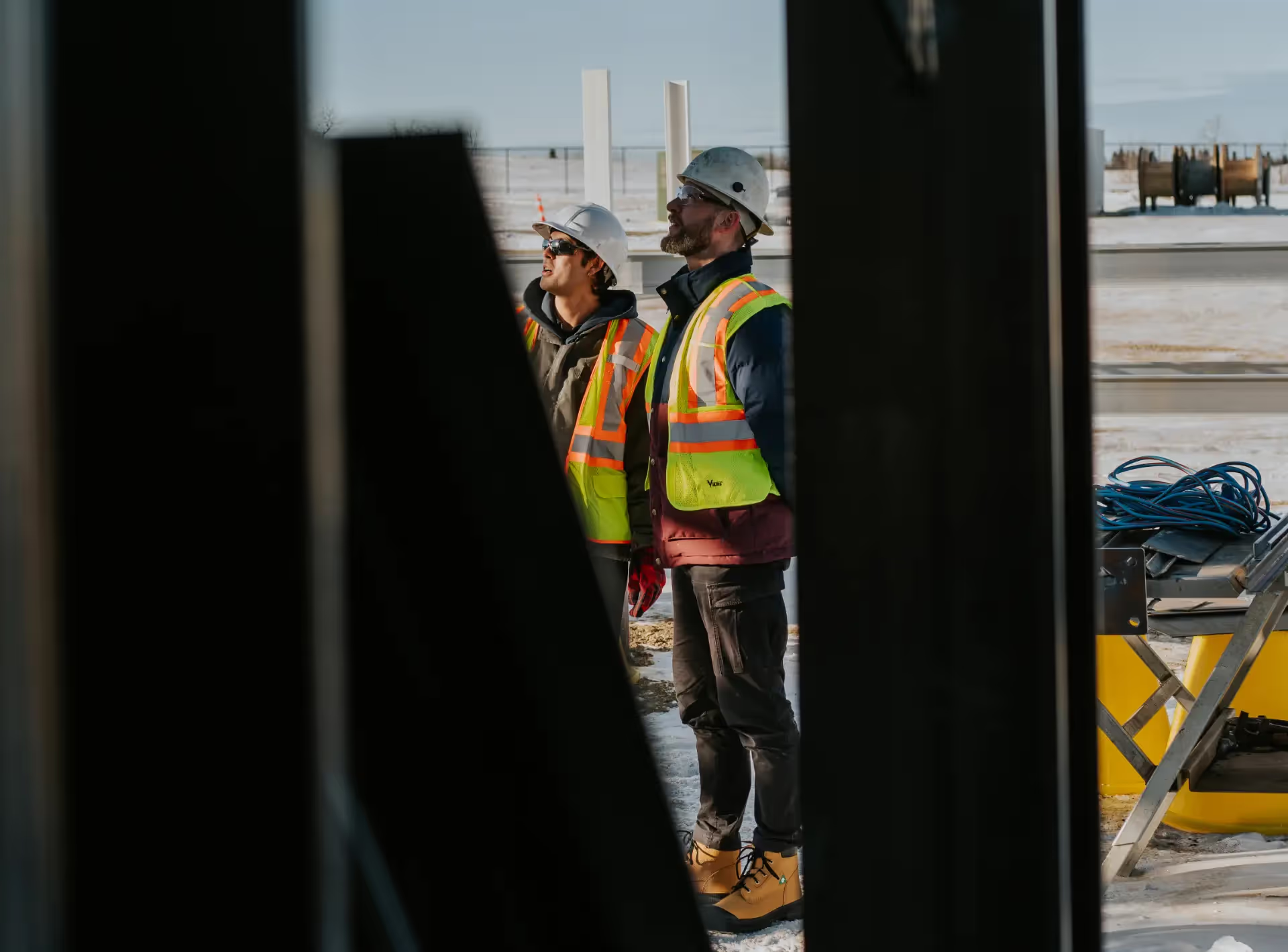
Airhive founders
Airhive’s 1,000-tonne-per-year system will be one of the largest operational DAC systems in the world and the largest operated by a UK company.
It is part of Deep Sky Alpha, a cross-technology DAC hub in Innisfail, Alberta. Airhive is one of several developers building out different DAC technologies at Deep Sky Alpha, which shares transportation and storage infrastructure. The Deep Sky facility recently sequestered its first volumes of CO2. As it ramps up to its operational capacity, Airhive’s system will now help accelerate Deep Sky Alpha, which has become one of the world’s most important DAC facilities.
Airhive is also rolling out its DAC technology through projects in the UK, Europe, and Canada. One of these is with Coca-Cola Europacific Partners, which will embed a 1,000-tonne-per-year DAC unit within a Coca-Cola bottling plant. Drinks will be made fizzy through direct-air-capture-derived bubbles of CO2. Encouraged by Canada’s tax incentives supporting carbon removal, Airhive plans to build a larger facility in Alberta that will capture CO2 and supply carbon credits to companies with net-zero targets.
Airhive’s progress in delivering DAC at commercial scale has been backed by leading climate investors and corporates.
The Direct Air Capture Market in November 2025
Carbon credits from DAC are some of the most expensive, but also the most sought-after, credits in the carbon market.
Bought by companies including Microsoft and JPMorgan, they trade at a premium because direct air capture is both verifiable and permanent: the amount of carbon removed from the atmosphere is precisely measurable within the closed system of DAC, and once the captured CO2 is sequestered underground it stays there for 10,000 or more years.
DAC credits are in short supply. Few plants are operating today, reflecting the technological challenges of building the first wave of DAC systems at commercially viable costs. High build and operating costs from the first wave of facilities have kept prices around $1,000 per tonne, based on market data, despite DAC developers signing future carbon-credit supply contracts at prices ranging from the low $100s to over $1,000.
Airhive is a leader in the second wave of producers expected to expand supply — and lower prices — through 2030. STRATOS, by far the world’s largest DAC plant, is nearing completion in the US.
Scientists at the Intergovernmental Panel on Climate Change (IPCC) have concluded that carbon removal will play an “indispensable” role in helping the world reach net zero greenhouse gas emissions by 2050. With many approaches still being developed, however, the amount of carbon removed from the atmosphere in recent years is a tiny fraction of the 8–10 billion tonnes that the IPCC indicates will be required annually by mid-century.
Subscribe to the newsletter
Daily decarbonization data and news delivered to your inbox
Follow the money flow of climate, technology, and energy investments to uncover new opportunities and jobs.
Latest issues
-
This Washington Plant Just Made Jet Fuel From Air
Inside This Issue ⚡ AirPlant One Opens in Moses Lake: America's First Commercial E-Jet Fuel Plant Begins Operations 🏗️ Inside Holcim’s CaptureLab, Our Industry’s First Carbon Capture Test Platform...
-
Stratos Passed Its Tests. So What's the Holdup?
Inside This Issue 🏭 Stratos DAC Delay: Inside the Holdup at the World's Largest Carbon Capture Plant 🍁 TD Bank Signs Two DAC Deals in a Week: Deep Sky Is First 🛫 Technip Energies, Airbus, Safran a...
-
$20M Bet: JPMorgan Is Burying Carbon Under the Rockies
Inside This Issue 🧪 Charm Industrial Secures 61,500-Ton Carbon Removal Purchase and $20 Million Debt Financing to Catalyze Growth ✈️ IATA Urges Bigger Green Aviation Fuel Push as Production Stagna...
Company Announcements
-
From Concept to Reality: Exmar Takes Delivery of First Ammonia-Fuelled Oceangoing Ship
The first in a series of ofur midsize gas carriers, Antwerpen will act as a proving ground for ammonia as a marine fuel, advancing low- and zero-carbon fuels and informing future vessel design Up ...
-
Bayer Hopes to Speed Up Biofuel Feedstock Plan Amid Iran War Energy Crunch
LONDON, June 10 (Reuters) - Bayer (BAYGn.DE), opens new tab is hoping to speed up a plan to facilitate North American production of biofuel feedstocks like camelina in the wake of the Iran war, the...
-
Mitsubishi Electric and Finland's VTT Establish Core Technology for Direct Ocean Capture
System uses gas-capture method and will accelerate societal implementation by integrating with existing infrastructure TOKYO--(Business Wire)--Mitsubishi Electric Corporation (TOKYO: 6503) today a...
-
FASTECH and Bosch Rexroth to Build World's Largest Hydrogen Refueling Station for Transit Buses
San Mateo County, California, USA, June 10, 2026 (GLOBE NEWSWIRE) -- FASTECH, in collaboration with Bosch Rexroth, announced that they have been contracted by the San Mateo County Transit District ...