
Three industrial partners have joined forces to build large-scale direct air capture infrastructure in Alberta, Canada. Heirloom Carbon Technologies, TKMS, and thyssenkrupp Calvion signed two Memorandums of Understanding on June 11, 2026, establishing a framework for research, technology transfer, and commercial-scale carbon dioxide removal in Canada. The collaboration aims to position Alberta as a global exporter of CDR credits and low-carbon fuels.
Key Facts
- Two MOUs signed June 11, 2026, by TKMS, Heirloom Carbon Technologies, and thyssenkrupp Calvion in Kiel/Edmonton
- Project location: Alberta, Canada, aligned with Canada's Industrial and Technological Benefits (ITB) policy
- Heirloom's limestone-based DAC technology accelerates natural CO2 absorption from years to just three days
- Heirloom is developing two DAC facilities in northwest Louisiana with a combined planned capacity of nearly 320,000 tonnes of CO2 per year
- The global DAC market is projected to grow from USD 91.21 million in 2026 to USD 4,256.21 million by 2034, at a CAGR of 61.67% (Fortune Business Insights, 2026)
- thyssenkrupp Calvion launched as a dedicated industrial decarbonization subsidiary on May 1, 2026, with approximately 40 employees
- Canada's federal investment tax credit for DAC equipment is 60%, with an additional 12% reported for Alberta projects (Decarbonfuse, October 2025)
>> In Other News: XCF Global Advances New Rise Reno Production-Start Sequence with Catalyst Activation Underway
What Does This Partnership Actually Do?
The three-way agreement combines proven DAC technology, industrial engineering capability, and committed capital into a single commercialization framework. Each partner brings a distinct role to the Alberta project.
Heirloom Carbon Technologies, headquartered in San Francisco, specializes in accelerated mineral carbonation. Its process uses limestone, an abundant and low-cost material, to pull CO2 directly from the atmosphere. Heirloom's technology compresses what naturally takes years into just three days, making it one of the lowest-cost DAC approaches currently available with peer-reviewed cost data.

"Our partnership with Heirloom Carbon Technologies and thyssenkrupp Calvion marks a decisive step toward building a world-class carbon-removal industry in Canada. By committing substantial investment to Alberta, we will not only bring proven DAC technology to Canada but also actively involve Canadian small and medium-sized businesses throughout the value chain, from components manufacturing to operations and services. Together we will demonstrate that large-scale, low-cost CO2 removal can be commercialised in Canada and exported globally, reinforcing Canada's leadership in the decarbonising economy."
Thomas Keupp, Chief Sales Officer, TKMS
TKMS, a German naval and industrial group headquartered in Kiel, is committing substantial investment to the Alberta project. The company's participation directly supports Canada's Industrial and Technological Benefits policy, which requires that foreign contractors above certain contract thresholds reinvest in the local economy through partnerships, technology transfer, and job creation.
thyssenkrupp Calvion, a wholly owned subsidiary of thyssenkrupp Polysius that commenced operations on May 1, 2026, brings the engineering backbone. Headquartered in Ennigerloh, Germany, with approximately 40 employees, the company specializes in oxyfuel technologies, large-scale materials handling, systems integration, and complex plant delivery. For the Alberta project, Calvion is designing a next-generation calciner using its oxyfuel expertise, enhanced by electrification platforms from Swedish greentech company SaltX Technology and its Electric Arc Calciner technology.
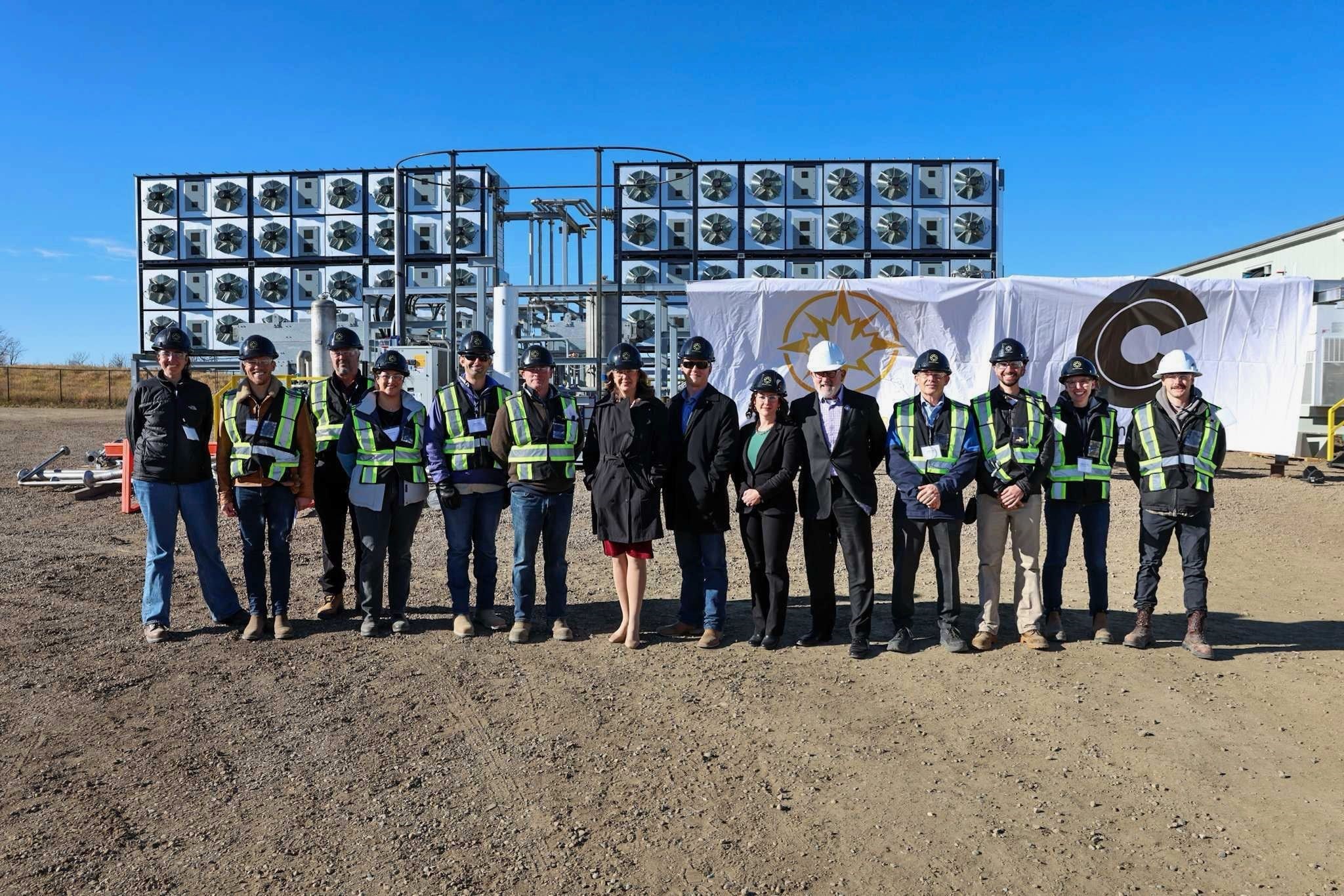
Why Is Alberta the Right Place for Large-Scale DAC?
Alberta has become a destination for direct air capture investment thanks to a combination of policy incentives, geology, and industrial infrastructure. Canada's federal investment tax credit for DAC equipment stands at 60%, with an additional 12% reported for Alberta projects, according to Decarbonfuse coverage of the CarbonCapture relocation to the province in October 2025. The province also sits on abundant saline aquifers suited to permanent CO2 geological storage.
Alberta's DAC ecosystem is already operational. In October 2025, True North Carbon's Tamarack project, at the Deep Sky Alpha facility near Innisfail, achieved first capture. It is Canada's largest single-technology DAC deployment, designed to remove up to 2,000 tonnes of CO2 per year. That same facility became the first in North America to sequester CO2 underground via direct air capture.
The TKMS-Heirloom-Calvion partnership targets a scale well beyond existing Alberta pilots. The MOUs establish a framework for a full DAC hub designed to produce CDR credits and low-carbon fuels for global export, making Canada a competitive supplier in the fast-growing carbon removal market.
The global DAC market is projected to grow from USD 91.21 million in 2026 to USD 4,256.21 million by 2034, at a compound annual growth rate of 61.67%, according to Fortune Business Insights. That growth reflects surging corporate demand for verified, permanent carbon removal.
>> RELATED: Why Canada's New Direct Air Capture Protocol Could Change the Climate Game
| Partner | Role in Alberta DAC Hub | Headquarters |
|---|---|---|
| Heirloom Carbon Technologies | Limestone-based DAC technology and CDR expertise | San Francisco, USA |
| TKMS | Substantial capital investment; ITB policy alignment | Kiel, Germany |
| thyssenkrupp Calvion | Engineering, scale-up, calciner design, systems integration | Ennigerloh, Germany |
| SaltX Technology | Electric Arc Calciner electrification platform for next-gen calciner | Sweden |
How Does Heirloom's Limestone Technology Work at Scale?
Heirloom's approach is built on accelerated mineral carbonation, a process that speeds up the natural rate at which limestone absorbs CO2. In nature, that absorption takes years. Heirloom compresses it to three days.
The company heats limestone in renewable-energy-powered calciners to release CO2 and produce calcium hydroxide. That material is spread on vertically stacked trays, where algorithms optimize its absorption capacity under different environmental conditions. Once the limestone has reabsorbed CO2 from the air, the cycle repeats and the CO2 is permanently stored underground.
Heirloom is currently developing two DAC facilities in northwestern Louisiana, at the Port of Caddo-Bossier near Shreveport, with a combined planned capacity of nearly 320,000 tonnes of CO2 per year. The first facility, with a capacity of around 17,000 tonnes per year, is expected to come online in 2026. The second is being developed as part of Project Cypress, a U.S. Department of Energy regional DAC hub eligible for up to USD 600 million in federal funding.
Heirloom's goal, as stated in its official communications, is to remove 1 billion tonnes of CO2 from the atmosphere by 2035. The company describes that figure as representing approximately 10% of the global carbon removal needed annually by 2050. The Alberta project would mark Heirloom's first major international deployment.

What Role Does thyssenkrupp Calvion Play in This?
thyssenkrupp Calvion is a new entity, carved out from thyssenkrupp Polysius on May 1, 2026, specifically to accelerate industrial decarbonization at scale. Starting with approximately 40 employees and a portfolio spanning oxyfuel technologies, DAC, green quicklime, and phosphogypsum recycling, Calvion was structured to move carbon capture solutions from concept to commercial deployment more quickly.

"Alberta's natural resource base, workforce and technical capacity are a compelling foundation for carbon removal research, development and large-scale deployment. Our partnership with TKMS and thyssenkrupp Calvion lays the foundation for investments that remove carbon, produce low carbon fuels, create durable jobs, and cement Canada's place in a decarbonizing global marketplace."
Max Scholten, Head of Commercialization, Heirloom Carbon Technologies
For the Alberta project, Calvion is designing a next-generation calciner combining its oxyfuel expertise with SaltX Technology's Electric Arc Calciner platform. SaltX's technology replaces fossil fuel-driven heating with electric plasma technology, enabling near-zero-emission calcination when powered by renewable energy. That electrification layer is what allows the DAC process to scale without generating a large carbon footprint of its own.
Calvion's capabilities include large-scale plant delivery and systems integration across emissions-intensive industries including cement and lime. Lukas Schoeneck, CEO of thyssenkrupp Calvion, has stated the company's ambition as bringing scalable carbon capture solutions to market faster, using an agile organizational structure built to support the full project lifecycle.
Heirloom Carbon Technologies explains its limestone-based direct air capture (DAC) process, which accelerates natural mineral carbonation to capture CO₂ from the atmosphere in just days. This matches the technology at the core of Heirloom’s partnership with TKMS and thyssenkrupp Calvion for large-scale DAC deployment in Alberta, Canada. (Official Heirloom channel, October 2025)
Building a CDR Export Economy in Canada
The Alberta DAC hub is designed to go beyond carbon removal alone. The three partners explicitly aim to position Canada as a global exporter of CDR credits and low-carbon fuels. That export goal is central to Canada's ITB policy, which the MOUs are structured to support.
Under the ITB framework, Canadian companies throughout the value chain will receive technology transfers, intellectual property rights, and access to capital. Local suppliers are expected to participate from components manufacturing through to operations and services, generating high-value jobs in Alberta's manufacturing sector.
The carbon removal credit market is growing. As of mid-2025, approximately 2.4 million tonnes of DAC credits had been sold through around 680 orders globally, according to CDR.fyi. Heirloom is among the top three DAC credit suppliers by volume, alongside 1PointFive and Climeworks, which together account for 80% of total DAC credits sold. Corporate buyers including Microsoft, Airbus, and Alphabet have already committed to large-scale DAC purchases as part of their net-zero strategies.
The global DAC market is projected to grow from USD 91.21 million in 2026 to USD 4,256.21 million by 2034, at a CAGR of 61.67% (Fortune Business Insights, 2026). Canada's combination of policy incentives, geological storage capacity, and industrial-grade partnerships puts it in a position to capture a meaningful share of that demand.
Frequently Asked Questions
What is the Heirloom, TKMS, and thyssenkrupp Calvion partnership in Canada?
The three companies signed two MOUs on June 11, 2026, to collaborate on large-scale direct air capture in Alberta. The framework covers research, technology transfer, and commercial DAC deployment aligned with Canada's Industrial and Technological Benefits policy.
How does Heirloom Carbon Technologies capture CO2?
Heirloom uses limestone to absorb CO2 through accelerated mineral carbonation, compressing a process that naturally takes years into just three days. After absorption, the CO2 is extracted and permanently stored underground. The technology runs on renewable energy.
Why is Alberta a strong location for direct air capture development?
Canada offers a 60% federal investment tax credit for DAC equipment, with an additional 12% reported for Alberta projects. The province has abundant saline aquifers for CO2 geological storage and a skilled industrial workforce. Alberta is already home to Canada's first underground CO2 sequestration via DAC at the Deep Sky Alpha facility near Innisfail.
From Framework to a Carbon Removal Industry
MOUs are frameworks, not finished facilities. But this partnership has assembled a credible foundation: proven DAC technology from Heirloom, next-generation calciner engineering from thyssenkrupp Calvion, and capital commitment from TKMS. Alberta's policy environment and existing DAC infrastructure reduce the deployment risk considerably.
Canada is no longer just talking about becoming a DAC hub. With the Tamarack project already capturing carbon, the Deep Sky Alpha facility already storing CO2 underground, and partnerships like this now formalized, Alberta is building the industrial base to become a durable, commercial-scale CDR supplier. The Heirloom-TKMS-Calvion collaboration is one of the clearest signals yet that large-scale, low-cost carbon removal in Alberta has moved from planning to construction.
For ongoing coverage of carbon removal, DAC, and corporate CDR procurement, subscribe to Decarbonfuse.com.
Subscribe to the newsletter
Daily decarbonization data and news delivered to your inbox
Follow the money flow of climate, technology, and energy investments to uncover new opportunities and jobs.
Latest issues
-
The US Hasn't Made Heavy Water Since 1982
Inside This Issue ⚛️ Aternium Completes FEED Studies for US Hydrogen, Heavy Water Project 🐄 Google, McKinsey Strike Brazil Carbon Removal Deal With Silvopasture Project 🔧 Cummins Selects Stargate ...
-
Why Colorado’s Koloma Has Japan’s Largest Utility Hooked
Inside This Issue ⚡ JERA Invests in Koloma to Explore Natural Hydrogen as a Future Low-Carbon Energy 🔬 New CATF Tool Provides Framework for Self-Assessment and Strengthening of Biomass Carbon Remo...
-
LNK Energies Targets $6.50 Hydrogen With No Federal Subsidies
Inside This Issue 🚛 MIT Startup Says It Can Turn Diesel Trucks Into Cheaper Hydrogen Haulers, See It at Disrupt 🏭 Baytown City Council Briefs: ExxonMobil Blue Hydrogen Agreement Approved 🌎 Colorad...
Company Announcements
-
A new interactive tool from Clean Air Task Force (CATF) provides a practical framework for the self-assessment and strengthening of biomass carbon removal (BiCRS) protocols to help ensure that carb...
-
LanzaJet Secures Financing to Scale SAF Production and Supply Global Customers
CHICAGO, Oct. 15, 2026 (GLOBE NEWSWIRE) -- LanzaJet, Inc., a leading next-gen fuels technology company and fuels producer, today announced fully committed new financing of at least $20 million to s...
-
44.01 and Frontier Advance Permanent CO₂ Storage Through In-Situ Mineralization
44.01's in-situ mineralization (ISM) process turns CO₂ into solid rock underground in a few years, after which the risk of reversal is functionally zero. >> In Other News: JERA Invests in ...
-
JERA Invests in Koloma to Explore Natural Hydrogen as a Future Low-Carbon Energy
JERA Co., Inc. (JERA), through its corporate venture capital arm JERA Ventures, has invested in Koloma, Inc. (Koloma), a U.S.-based natural hydrogen exploration and development company. The invest...