
Approval in Principle (AiP) for World's First LCO₂ / Methanol Carrier
Published by Todd Bush on June 30, 2025
Tokyo, June 30, 2025 - Mitsubishi Shipbuilding Co., Ltd., a part of Mitsubishi Heavy Industries (MHI) Group, and Mitsui O.S.K. Lines, Ltd. (MOL) have acquired Approval in Principle (AiP)(Note1) from Nippon Kaiji Kyokai (ClassNK) for their jointly developed liquefied CO2 (LCO2) / methanol carrier. AiP acquisition for this type of carrier marks a world's first(Note2).
>> In Other News: KAIST AI Advances CO₂-Selective Material Discovery
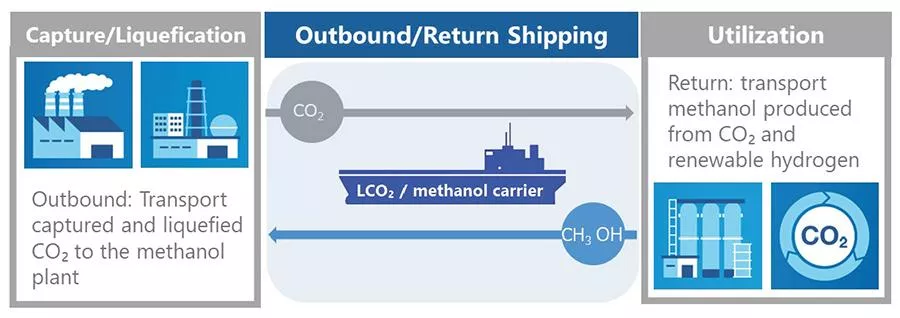
Conceptual diagram of LCO2 / methanol carrier operation
Technologies for converting CO2 into fuel or chemical products are attracting attention as a means of utilizing CO2 in CCUS (Carbon dioxide Capture, Utilization and Storage). One such approach is the ongoing study toward realizing a supply chain for producing synthetic methanol(Note3) from captured CO2. Synthetic methanol is expected to serve as one of the marine fuels that will contribute to decarbonization in the maritime shipping industry.
The vessel for which Mitsubishi Shipbuilding and MOL acquired AiP is based on a low-pressure LCO2 carrier. It aims to transport CO2, which serves as raw material, on outward voyages and synthetic methanol on return voyages. Use of dedicated vessels for CO2 or methanol results in empty-cargo operation on half of their trips. If dual transport of CO2 and methanol is achieved, empty-cargo trips can be eliminated, thereby improving overall transport efficiency. Mitsubishi Shipbuilding and MOL will move forward with the development of the LCO2 / methanol carrier, building on the findings and technical challenges identified during the concept study. The goal is to achieve commercialization of the LCO2 / methanol carrier through collaboration with relevant companies in the supply chain and other partners.
MHI Group is currently pursuing strategic measures to strengthen its business for the energy transition. In conjunction with this initiative, Mitsubishi Shipbuilding is making efforts to contribute to the advancement of the maritime industries in Japan and around the world by utilizing its shipbuilding-based marine engineering technologies in addition to conventional shipbuilding. The development of LCO2 / methanol carrier is one example of these efforts. Collaboration with MOL also demonstrates MHI Group's commitment to partnerships. Moving forward, Mitsubishi Shipbuilding will continue to build strategic global partnerships both to incorporate external expertise and actively advance the development of a CCUS value chain. Through these efforts, the company aims to provide its technologies, products and services to ever more customers.
The MOL Group is currently working to build supply chains for synthetic fuel/methanol and CO2 through initiatives such as its investment in HIF Global LLC(Note4), a U.S.-based company that develops, produces and transports synthetic fuel/methanol across North and South America and Australia. LCO2 / methanol carrier is expected to enhance the overall economic viability of such supply chains and contribute significantly to their realization. In line with the "MOL Group Environmental Vision 2.2," MOL is targeting net-zero emissions Groupwide by 2050. By further accelerating initiatives to transport CO2 as well as to develop and supply synthetic methanol, MOL aims to contribute to realization of a low-carbon or decarbonized society.
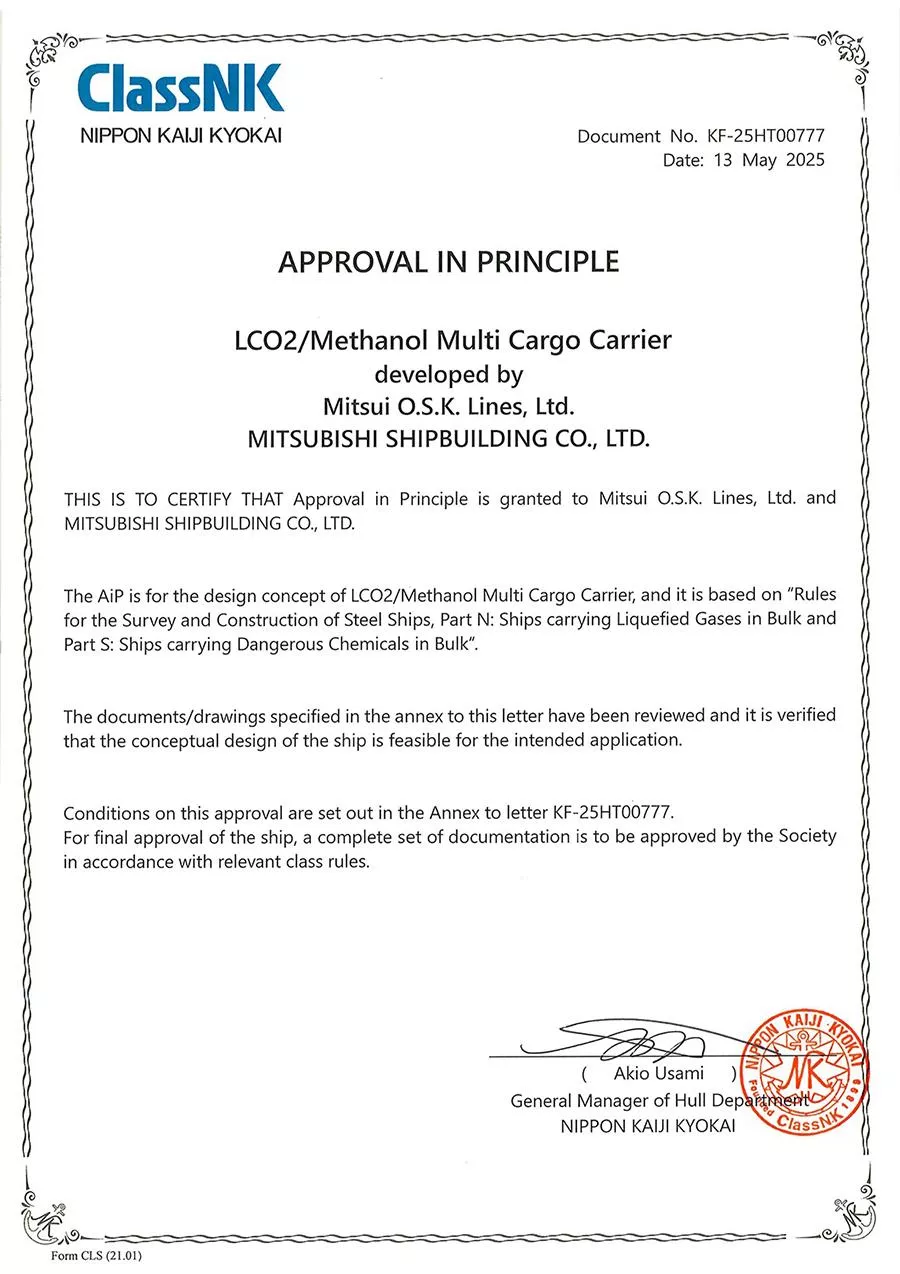
Note 1 Approval in Principle (AiP) indicates that a certification body has reviewed the basic design of the subject equipment and confirmed that it meets technical requirements and relevant safety standards. In this case, the inspection was conducted based on the IGC Code (International Code for the Construction and Equipment of Ships Carrying Liquefied Gases in Bulk), IBC Code (International Code for the Construction and Equipment of Ships Carrying Dangerous Chemicals in Bulk), and ClassNK Classification Rules applicable to ships transporting liquefied gases and dangerous chemicals in bulk.
Note 2 Based on surveys performed by Mitsubishi Shipbuilding and MOL.
Note 3 Synthetic methanol (e-methanol) is a synthetic fuel made from CO2 and hydrogen generated from renewable energy.
Note 4 For details, see MOL's press release issued September 20, 2024: https://www.mol.co.jp/en/pr/2024/24108.html
Subscribe to the newsletter
Daily decarbonization data and news delivered to your inbox
Follow the money flow of climate, technology, and energy investments to uncover new opportunities and jobs.
Latest issues
-
Oil Sands Alliance Faces $43.7 Billion Price Tag
Inside This Issue 🍁 Alberta Cuts Carbon Costs to Fast-Track Pathways CCS 🏛️ EU Unveils Sweeping ETS Overhaul With €100 Billion Industrial Decarbonisation Bank 🌱 Consultation: Major Revision to Bio...
-
Wall Street Pours $1.7B Into Fuel Cells for AI
Inside This Issue 🔋 IDF, Oaktree to Invest $1.7 Billion in Bloom Energy Fuel Cells for AI Infrastructure 🌬️ Airhive Acquires Carbyon, Creating a European Leader in Low-Cost Direct Air Capture Tech...
-
AI Data Centers Just Went Hydrogen, Bosch Is In
Inside This Issue ⚡ ECL and PowerCell Announce 300 MW+ Hydrogen Power Strategic Partnership for AI Data Centers, Supported by Bosch 🍁 Canada, Alberta Ease TIER Carbon Rules to Fast-Track Pathways ...
Company Announcements
-
JERA Co., Inc. (JERA), a global energy leader and Japan's largest power generation company, today announced that it has signed a Memorandum of Understanding (MoU) with Samsung C&T Corporation (...
-
ZeroAvia and Safran Forge Partnership on Hydrogen-Electric Technologies
ZeroAvia and Safran have announced the launch of a collaboration dedicated to hydrogen-electric propulsion technologies for aviation. This partnership combines ZeroAvia’s cutting-edge expertise in ...
-
Clean Fuels Welcomes Hawaii Clean Fuel Standard for Alternative Fuels
JEFFERSON CITY, MO, Clean Fuels Alliance America applauds Hawaii Governor Josh Green, M.D., for signing legislation to create a clean fuel standard for the State of Hawaii. This new law will help d...
-
Air Liquide Invests Over 160M USD in the U.S. to Supply Advanced Chips Manufacturing in Arizona
Air Liquide announces a new investment of over 160 million US dollars to build, own and operate a new large-scale production facility in Arizona to supply essential ultra-high purity gases to the l...