
EIA: US Biodiesel And Renewable Diesel Imports Fall Sharply In 2025 After Tax Credit Change
Published by Todd Bush on September 5, 2025
September 5, 2025BY U.S. Energy Information Administration
U.S. imports of biodiesel and renewable diesel significantly decreased in the first half of 2025 (1H25) compared with the same period in previous years. This decline is primarily due to the loss of tax credits for imported biofuels and generally lower domestic consumption of these fuels.
Renewable diesel and biodiesel are biomass-based diesel fuels that can replace petroleum-based distillate and be used to comply with the Renewable Fuel Standard blending requirements for refiners administered by the U.S. Environmental Protection Agency.
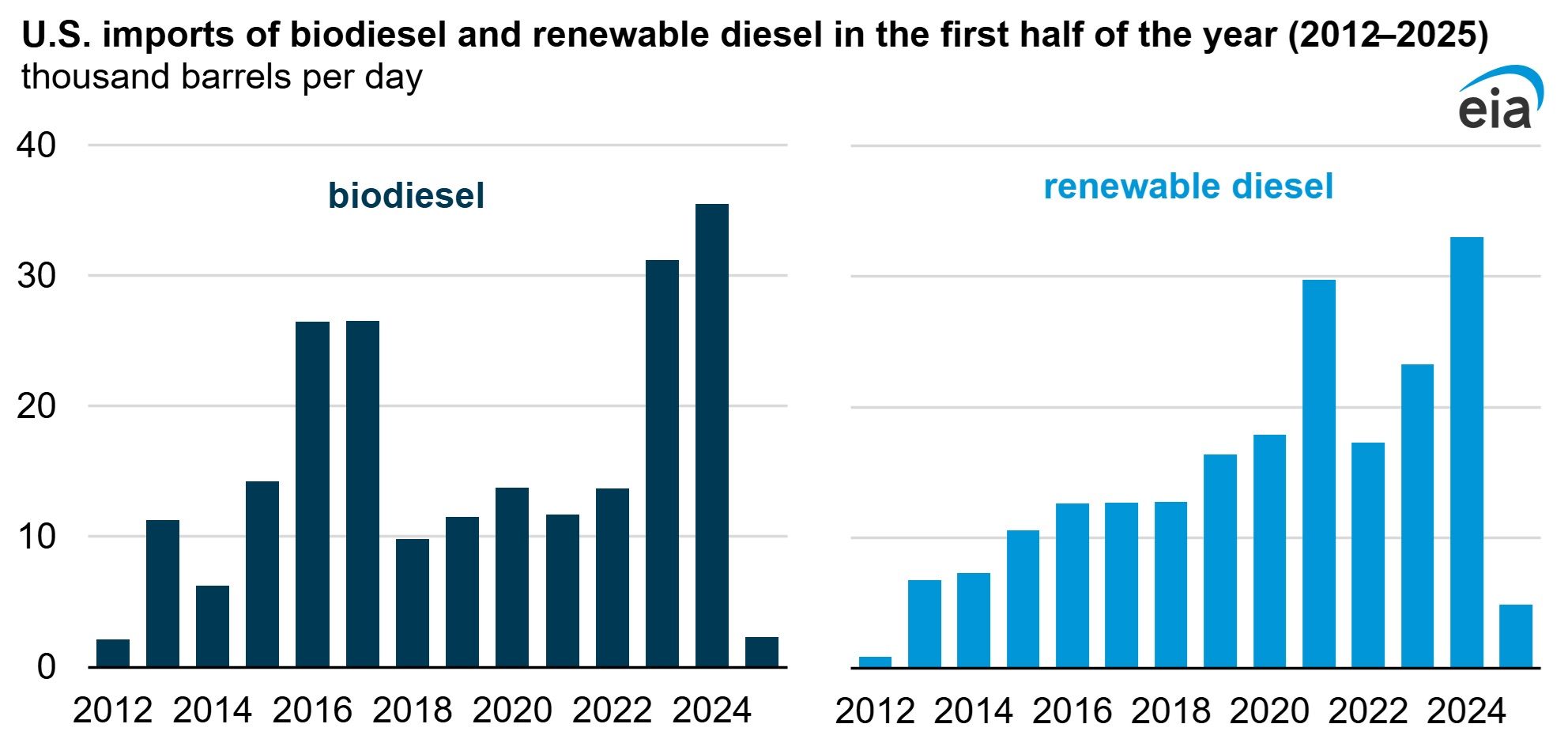
Data source: U.S. Energy Information Administration, Petroleum Supply Monthly Note: Consumption is defined as product supplied plus refinery and blender net inputs.
>> In Other News: US SAF Production Hits Critical 30,000 BPD Milestone
In 1H25, U.S. biodiesel imports averaged 2,000 barrels per day (b/d), a sharp drop from 35,000 b/d in 1H24. Renewable diesel imports averaged 5,000 b/d, down from 33,000 b/d in 1H24. These import levels were the lowest for the first half of any year since 2012, when U.S. biodiesel consumption was less than half of 2024 levels and renewable diesel consumption was negligible.
One key reason for the sharp drop in biodiesel and renewable diesel imports in early 2025 is the loss in tax credits for imported biofuels. Before 2025, both imported and domestically produced biodiesel and renewable diesel received a $1 per gallon blender’s tax credit (BTC). The Inflation Reduction Act replaced the BTC with the Section 45Z Clean Fuel Production Credit in 2025, which only applies to domestic production. This tax credit change placed imports at a relative economic disadvantage.
A second reason biodiesel and renewable diesel imports dropped in 1H25 was low U.S. consumption of these fuels because of uncertainty around blending requirements and negative profit margins for blending biofuels. Compared with 1H24, U.S. consumption of renewable diesel was down about 30% in 1H25, and biodiesel consumption was down about 40%. This lower consumption reduced demand for both imported and domestically produced biofuels.
The combination of poor blending margins and the relative economic disadvantage for imported biofuels led domestic blenders to rely on domestically produced biofuels for the smaller amounts they were blending. As a result, international biofuel producers found fewer profitable opportunities to send product to the United States. For example, Neste, the producer of all of the renewable diesel imported to the United States, reported a lower share of exports going to the United States in 1H25 than in 1H24. Looking ahead, we expect U.S. consumption of biodiesel and renewable diesel to increase as the year progresses to meet existing RFS mandates, but imports of the fuels will likely remain low because of the change in tax policy.
Although we do not explicitly forecast biodiesel and renewable diesel imports in the Short-Term Energy Outlook, we do forecast U.S. net imports. We assume low imports for both products in the forecast period and forecast U.S. biodiesel net imports in 2025 and 2026 to be their lowest since 2012.
About U.S. Energy Information Administration
The U.S. Energy Information Administration (EIA) collects, analyzes, and disseminates independent and impartial energy information to promote sound policymaking, efficient markets, and public understanding of energy and its interaction with the economy and the environment.
Subscribe to the newsletter
Daily decarbonization data and news delivered to your inbox
Follow the money flow of climate, technology, and energy investments to uncover new opportunities and jobs.
Latest issues
-
Oil Sands Alliance Faces $43.7 Billion Price Tag
Inside This Issue 🍁 Alberta Cuts Carbon Costs to Fast-Track Pathways CCS 🏛️ EU Unveils Sweeping ETS Overhaul With €100 Billion Industrial Decarbonisation Bank 🌱 Consultation: Major Revision to Bio...
-
Wall Street Pours $1.7B Into Fuel Cells for AI
Inside This Issue 🔋 IDF, Oaktree to Invest $1.7 Billion in Bloom Energy Fuel Cells for AI Infrastructure 🌬️ Airhive Acquires Carbyon, Creating a European Leader in Low-Cost Direct Air Capture Tech...
-
AI Data Centers Just Went Hydrogen, Bosch Is In
Inside This Issue ⚡ ECL and PowerCell Announce 300 MW+ Hydrogen Power Strategic Partnership for AI Data Centers, Supported by Bosch 🍁 Canada, Alberta Ease TIER Carbon Rules to Fast-Track Pathways ...
Company Announcements
-
JERA Co., Inc. (JERA), a global energy leader and Japan's largest power generation company, today announced that it has signed a Memorandum of Understanding (MoU) with Samsung C&T Corporation (...
-
ZeroAvia and Safran Forge Partnership on Hydrogen-Electric Technologies
ZeroAvia and Safran have announced the launch of a collaboration dedicated to hydrogen-electric propulsion technologies for aviation. This partnership combines ZeroAvia’s cutting-edge expertise in ...
-
Clean Fuels Welcomes Hawaii Clean Fuel Standard for Alternative Fuels
JEFFERSON CITY, MO, Clean Fuels Alliance America applauds Hawaii Governor Josh Green, M.D., for signing legislation to create a clean fuel standard for the State of Hawaii. This new law will help d...
-
Air Liquide Invests Over 160M USD in the U.S. to Supply Advanced Chips Manufacturing in Arizona
Air Liquide announces a new investment of over 160 million US dollars to build, own and operate a new large-scale production facility in Arizona to supply essential ultra-high purity gases to the l...