
Emvolon, an MIT spinout turning waste methane into liquid fuels, has signed two separate definitive agreements with Freepoint Commodities. The first is a seven-year purchase framework worth more than $450 million. The second gives Freepoint direct co-investment rights across Emvolon's project portfolio.
Together, they solve the two hardest problems in decentralized fuel deployment: finding a bankable buyer and securing project capital.
Key Facts
- Agreement 1: Seven-year Commodity Purchase Framework valued at more than $450 million (Emvolon/Freepoint, August 2026)
- Agreement 2: Separate co-investment right giving Freepoint equity and debt participation across Emvolon's project portfolio
- Scale target: 300,000 metric tons of biomethanol and associated liquid fuels per year as the portfolio expands
- First named commercial site: Atascocita Humble Renewable Energy (HRE) facility, Humble, Texas, up to 6,000 metric tons of green methanol annually
- Production start target at the Texas site: 2027
- Global methanol market: $40 billion annually (Emvolon, 2026)
- RED-II-compliant biomethanol trading above $1,000 per metric ton as of August 2026
- Emvolon founded 2021, headquartered in Woburn, Massachusetts
- Freepoint founded 2011, Stamford, Connecticut, 600+ employees worldwide
>> In Other News: Summit Forfeits Two CO2 Storage Permits in North Dakota, Continues Legal Fight Over Third
Why Keep the Two Agreements Separate?
Both deals were announced together, but they do different jobs. The Commodity Purchase Framework is a commercial agreement. Freepoint commits to buying biomethanol and other liquid fuels from Emvolon's sites over seven years.
Volumes are structured to reach 300,000 metric tons annually. That kind of long-term, named-buyer commitment is what project lenders need before they will finance construction.
The co-investment agreement is a financial one. Freepoint secures the right to place equity and debt directly into individual Emvolon projects. For a modular fuel developer trying to replicate sites at scale, the combination removes two sequential financing bottlenecks at once.
The structure matters because 2026 has become the year where offtake and capital structure are increasingly paired in clean fuel deals. Signing one without the other typically leaves projects waiting months before debt financing can close.
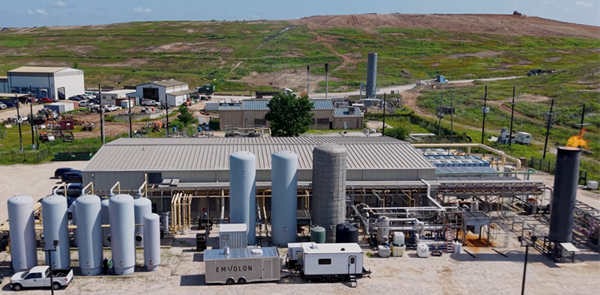
Emvolon's modular systems are designed to fit inside standard shipping containers and deploy directly at landfills, dairy farms, and industrial gas sites.
How Does Emvolon's Technology Actually Work?
Emvolon repurposes automotive engines as modular chemical reactors. The engines run fuel-rich, meaning more methane is injected than the available air can combust. That produces syngas, a blend of hydrogen and carbon monoxide, which is then converted into liquid methanol on-site.
Each unit fits inside a 40-foot shipping container. It can produce up to 8 metric tons of methanol per day from 300,000 standard cubic feet of methane gas, according to Emvolon's published specifications.
Units stack in parallel to scale capacity and power themselves using residual gas. No grid connection is needed. That portability is the core commercial advantage for distributed waste sites like landfills and dairy farms, where central plant economics simply don't work.
Modular, on-site conversion of waste methane to methanol sidesteps expensive pipeline and grid infrastructure. It brings the production unit to the gas source, not the other way around.
Emvolon's official video explaining how its modular, engine-based technology converts stranded methane into green methanol at the source of waste (published September 2025).
Where Is the First Commercial Site?
The first named site is the Atascocita Humble Renewable Energy (HRE) facility in Humble, Texas. It runs under a joint venture Emvolon signed with Montauk Renewables in August 2025. Production is targeted to begin in 2027.

"This dual commercial and capital agreement with Freepoint systematically solves the core bottleneck in decentralized fuel manufacturing by securing our buyer and anchoring our project financing platform. We are building our first commercial system now and will put that foundation to work across North America and key international growth regions."
Emmanuel Kasseris, Ph.D., Co-Founder and CEO, Emvolon
The HRE site will convert a flared landfill gas stream into up to 6,000 metric tons of low-carbon methanol per year. That volume is a small fraction of the 300,000 metric ton scale target. It's the proof point that unlocks replication across the broader portfolio.
The Montauk JV is designed to extend across multiple sites in Montauk's development pipeline. Landfills, dairy farms, wastewater facilities, and industrial gas sites are all target feedstock types. The Freepoint deal now gives every replicated site a buyer and capital committed in advance.
>> RELATED: Green Plains Enters into Agreement with Freepoint Commodities to Monetize 45Z Tax Credits
| Feedstock / Site Type | Example | Key Feature |
|---|---|---|
| Landfill gas | Humble, Texas (HRE site, first commercial) | Up to 6,000 MT methanol/year; production start 2027 |
| Agricultural biogas (dairy farms) | Target site type across North America | Stranded methane that cannot reach the pipeline grid |
| Industrial flare gas | Target site type, international growth regions | Gas currently flared or vented; no pipeline needed |
| Wastewater treatment | Target site type, North America portfolio | Biogas from sewage treatment converted on-site |
What Market Is Emvolon Targeting?
Methanol is a $40 billion global annual market. Demand spans maritime shipping, chemicals, and heavy transport. A newer pathway converts methanol into sustainable aviation fuel, adding another demand layer.
Green methanol has become a priority fuel for the shipping industry as the International Maritime Organization tightens carbon intensity rules. The Methanol Institute estimates global maritime methanol demand could reach 14 million metric tons annually by 2030.
RED-II-compliant biomethanol, the type Emvolon produces, was trading above $1,000 per metric ton as of August 2026. That premium reflects a supply deficit for low-carbon fuel in a regulated European market.
Maritime shipping decarbonization and sustainable aviation fuel scale-up both create end markets for Emvolon's biomethanol. Freepoint's global physical distribution network handles delivery to those markets directly.

"Emvolon's modular deployment model offers a practical solution to localized fuel production. Our dual commercial and capital commitment reflects our commitment to renewable chemicals and fuels."
Mark Lay, Managing Director, Freepoint Commodities
How Does Freepoint Fit Into the Deployment Model?
Freepoint is not a passive buyer in this structure. The Stamford, Connecticut-based commodity merchant employs more than 600 people worldwide and operates a global physical distribution network. That network is how biomethanol produced at distributed North American sites reaches maritime and chemical customers in regulated markets.
The co-investment right is equally important. It lets Freepoint place equity and debt at the individual project level, not just at the company level. Each new site can draw on Freepoint's balance sheet to bridge the gap between early development and long-term project debt.
Sustainable methanol production at distributed sites has historically struggled to attract project finance. No single site is large enough to justify standalone lender attention. The Freepoint structure treats the full portfolio as the bankable unit instead.

Freepoint Commodities operates a global physical distribution network that will receive and distribute biomethanol from Emvolon's portfolio of modular production sites.
What This Deal Proves for the Sector
The Emvolon-Freepoint transaction is a commercial template, not just a company milestone. It shows that modular waste-to-fuels technology can attract a commodity-grade offtake and a balance-sheet capital partner at the same time. That pairing has been the missing piece for most distributed fuel startups.
The deal also names a first commercial site and sets a production date. The Humble, Texas project gives the portfolio a tangible anchor. The Freepoint purchase framework is sized for a much larger fleet of sites than one.
RED-II-compliant biomethanol trading above $1,000 per metric ton means Emvolon's economics work at current market prices without subsidy dependence. For waste gas site operators, the model is fully turnkey.
Emvolon brings the technology. Freepoint brings the buyer and the capital. The site operator converts a previously flared emission into revenue.

Emvolon's three-pillar model pairs site feedstock sourcing, modular on-site conversion, and the Freepoint offtake and capital framework. The structure is designed to replicate across waste-to-fuels projects at scale.
What Happens Next
Construction of Emvolon's first commercial system at the Humble, Texas site is underway as of August 2026. The Freepoint purchase framework and co-investment structure are now in place. Together they extend that template to landfill, agricultural, and industrial gas sites across North America and beyond.
With maritime shipping biomethanol demand growing and RED-II-compliant supply still scarce, a bankable offtake commitment at commercial scale is well timed.
Frequently Asked Questions
What is the difference between the two Emvolon-Freepoint agreements?
The first is a seven-year Commodity Purchase Framework worth more than $450 million. Under it, Freepoint commits to buy biomethanol and associated liquid fuels from Emvolon's sites. The second is a separate co-investment agreement giving Freepoint the right to place equity and debt directly into individual projects in Emvolon's portfolio. The two agreements address commercial offtake and project financing as distinct challenges.
Where is Emvolon building its first commercial methanol site?
The first named commercial site is the Atascocita Humble Renewable Energy (HRE) facility in Humble, Texas, developed under a joint venture with Montauk Renewables. The site will convert landfill flare gas into up to 6,000 metric tons of green methanol per year, with production targeted to begin in 2027.
Why is RED-II-compliant biomethanol trading above $1,000 per metric ton?
The European Union's Renewable Energy Directive II sets carbon intensity thresholds for liquid fuels used in transport. Biomethanol from waste gases qualifies under those rules. Demand from maritime shipping and chemicals is outpacing current supply, driving the price premium. Emvolon's modular model adds supply from distributed waste sites that have no other viable route to market.
For ongoing coverage of sustainable fuels, waste-to-energy, and modular decarbonization technology, subscribe to Decarbonfuse.com.
Subscribe to the newsletter
Daily decarbonization data and news delivered to your inbox
Follow the money flow of climate, technology, and energy investments to uncover new opportunities and jobs.
Latest issues
-
113 CCS Projects: What's Driving the Surge?
Inside This Issue 🏭 Global CCS Hits 113 Projects as Americas Lead Capacity 💰 We're Moving $2M+ to Climate Solutions 💧 China Launches World's First Semi-submersible Offshore Wind-to-hydrogen Platfo...
-
Why Is Wyoming Giving 650,000 Acres to Carbon Storage?
Inside This Issue 🪨 Inside Blm's 650,000-Acre Bet on Wyoming Carbon Storage 🏭 California Advances Carbon Capture and Removal Regulations Under SB 905 ⚡ Why a Japanese Power Giant Is Betting on Den...
-
Colorado Joins the 7-State CCS Permit Fast Lane
Inside This Issue ⚖️ Colorado Takes Over Class VI Permits: What Changes for CCS? 🏭 Hebei Shoulang Facility Using LanzaTech Technology Achieves World’s First ISCC EU RCF Certification for Ethanol P...
Company Announcements
-
China Launches World's First Semi-Submersible Offshore Wind-to-Hydrogen Platform
The world's first semi-submersible offshore wind-to-hydrogen platform has floated in Jiangmen, south China's Guangdong Province, opening a new avenue for the development and utilization of clean ma...
-
We’re Moving $2M+ to Climate Solutions
New companies, new ways to back existing ones, and every purchase built to pull in more capital We’re adding new companies to our portfolio and getting creative with how we put more money behind e...
-
Citi Closes $72 Million Carbon Removal-Linked Note to Support Applied Carbon Biochar Project
HIGHLIGHTS Citi structured an innovative $72 million carbon removal-linked note to provide upfront capital for Applied Carbon's biochar project, marking a first-of-its-kind "outcome bond" for ver...
-
New platform opens access to the same rigorous project evaluations trusted by the world's leading carbon removal procurement programs Today, Relae (formerly Carbon Direct) launched The Diligence C...