
ExxonMobil And BASF Join Forces To Advance Low-Emission Hydrogen Through Methane Pyrolysis Technology
Published by Todd Bush on November 18, 2025
- Industry leaders team up to accelerate methane pyrolysis—a technology that produces low-emission hydrogen and solid carbon.
- Methane pyrolysis complements both companies’ technology portfolios.
- A demonstration plant is planned in Baytown, Texas, to validate the technology at scale.
ExxonMobil and BASF have formed a strategic collaboration to advance methane pyrolysis technology, a next step toward delivering efficient, cost-competitive, low-emission hydrogen solutions for industrial use. The companies have signed a joint development agreement to co-develop methane pyrolysis technology, including plans to construct a demonstration plant aimed at commercial readiness.
Strength in collaboration
“This collaboration combines technological innovations and industrial expertise of ExxonMobil and BASF to accelerate the development of low-emission hydrogen,” said Mike Zamora, president of ExxonMobil Technology and Engineering Company. “Methane pyrolysis holds real potential, especially in regions where traditional carbon capture and storage solutions are less viable. ExxonMobil brings decades of deep technical knowledge in methane pyrolysis and a shared commitment to innovation.”
BASF has been developing methane pyrolysis technology over the past several years in a project funded by the German Federal Ministry of Research, Technology and Space (BMFTR).
“This novel methane pyrolysis technology generates competitive low-emission hydrogen and has a high potential for further reduction of the carbon footprint of our product portfolio. In line with our new Winning Ways Strategy, it will contribute to our ambition to be the preferred chemical company to enable our customers’ green transformation,” said Dr. Stephan Kothrade, member of the Board of Executive Directors and Chief Technology Officer at BASF. “We have been working on this technology for more than a decade and developed a superior reactor concept that we successfully validated at our test plant in Ludwigshafen. By combining BASF’s process innovation with ExxonMobil’s scale-up expertise we are bringing this cost-efficient low-emission hydrogen solution closer to economically viable industrial deployment.”
>> In Other News: Blue Ammonia Boom: U.S. Market Eyes 3,200% Surge
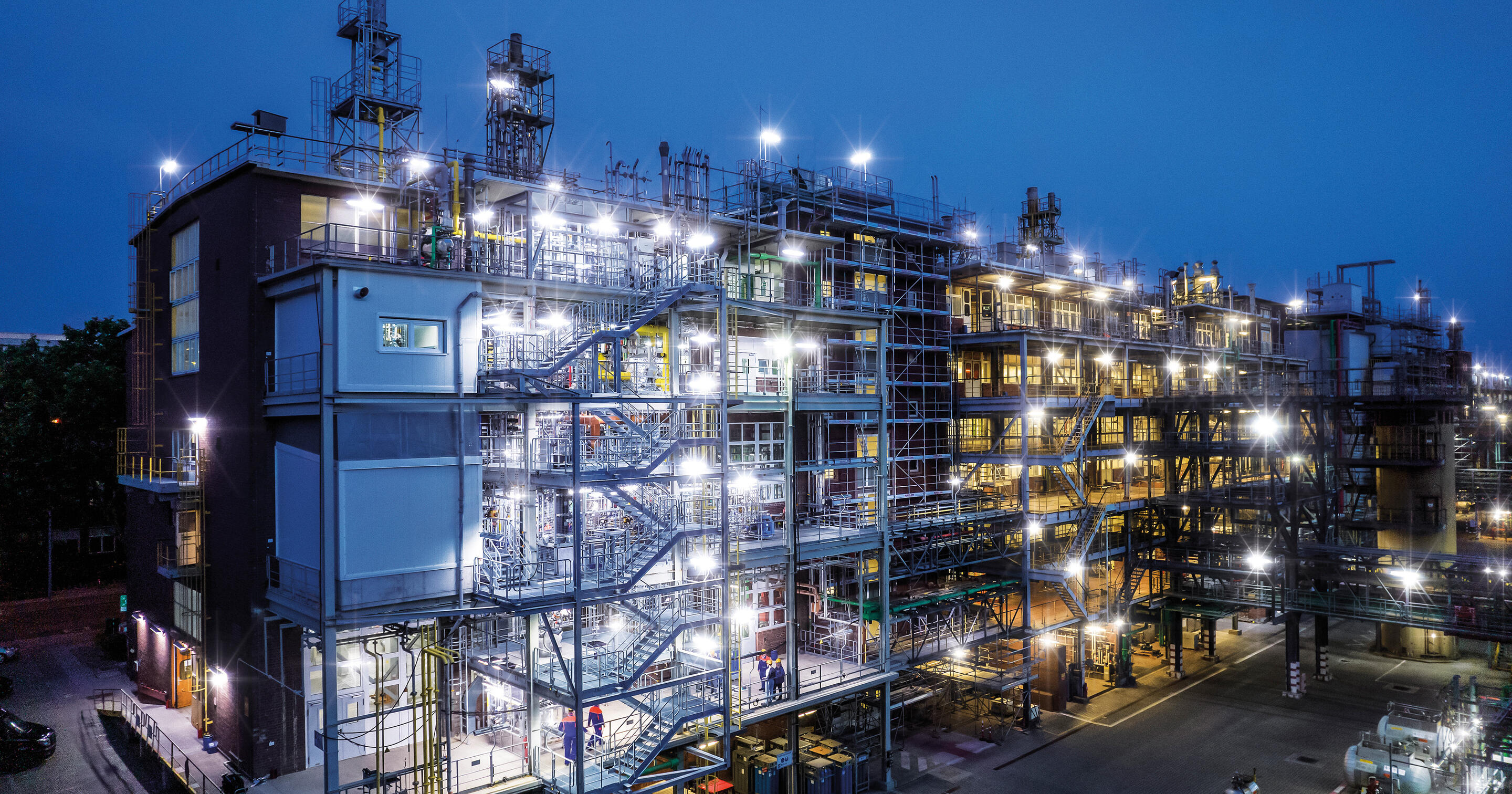
Ludwigshafen site(Feature Image: BASF - Methane pyrolysis pilot plant in Ludwigshafen, Germany)
A competitive approach to low-emission hydrogen
Methane pyrolysis uses electricity to convert natural gas or other gases, like bio-methane, into hydrogen and solid carbon. The technology offers several significant advantages: it does not generate process-related CO2 emissions, unlike traditional methods such as steam-methane reforming, requires approximately five times less electrical energy than water electrolysis and does not require the use of water. Moreover, it leverages existing natural gas infrastructure, and therefore is easily deployable in different locations. The lack of process CO2 emissions makes it particularly attractive for regions where carbon capture and storage face geologic, technical or policy-related challenges.
This process creates two valuable products: low-emission hydrogen and high-purity solid carbon. Hydrogen is both an important energy carrier and an essential feedstock in the chemical industry. The solid carbon has applications across multiple industries including steel, aluminum manufacturing, construction and advanced carbon products, like battery materials.
Demonstration plant to advance commercial readiness
The companies plan to construct and operate a demonstration plant capable of producing up to 2,000 tons of low-emission hydrogen and 6,000 tons of solid carbon product annually. This facility – which will be located at ExxonMobil’s Baytown Complex – will serve as a critical step toward commercial readiness and help validate the technology at scale.
Strategic milestone for hydrogen solutions
Methane pyrolysis technology complements ExxonMobil's broader strategy to deliver hydrogen solutions that work across geographies and infrastructure realities. ExxonMobil is committed to delivering solutions in the hydrogen value chain, and this collaboration marks a strategic milestone in the company’s pursuit of scalable, efficient and globally deployable hydrogen solutions.
Building the future of hydrogen - one molecule at a time.
Subscribe to the newsletter
Daily decarbonization data and news delivered to your inbox
Follow the money flow of climate, technology, and energy investments to uncover new opportunities and jobs.
Companies
Latest issues
-
Heidelberg's $1.36B Edmonton Plant Is on Hold. Here's Why.
Inside This Issue 🚧 Carbon Price Gap Stalls Heidelberg Materials' $1.36B Edmonton Cement Carbon Capture Project ⛽ Shanghai Electric Contributes to World-Record Biomethanol Bunkering Operation ⚖️ I...
-
Mombak Delivered 21,000 Google Carbon Tonnes Two Years Early
Inside This Issue 🌱 Mombak Beat Google's 2028 Carbon Deadline by Two Years 🛫 China's First SAF Compliance Service for Foreign-Registered Business Jets Successfully Implemented ✈️ UMeWorld Advances...
-
IRS Just Gave Carbon Capture Projects a Longer Runway
Inside This News ⚡ IRS Expands and Extends 45Q Safe Harbor, Offering Long-Term Certainty to Carbon Capture Projects 🌊 South Korea Signs MoU for 320MW Green Hydrogen Complex 🌱 Senken and Carbonsate...
Company Announcements
-
Research to be presented at COM 2026 highlights Novacium’s proprietary HyDRAS™ process, which combines black dross and bauxite residue to produce hydrogen while recovering value from aluminum indu...
-
Shanghai Electric Contributes to World-Record Biomethanol Bunkering Operation
SHANGHAI, Aug. 20, 2026 /PRNewswire/ -- On August 17, Shanghai Electric partnered with Shanghai International Port Group and CMA CGM Group to conduct a biomethanol bunkering operation with a total ...
-
MISSISSAUGA, Ontario, Aug. 18, 2026 /PRNewswire/ -- Next Hydrogen Solutions Inc. is pleased to announce that it has completed a Basic Design Engineering Package (BDEP) for a planned 10 MW fueling s...
-
Syzygy Plasmonics and IFC Partner to Advance Sustainable Aviation Fuel Projects Across Latin America
Framework agreement supports the development of Syzygy's SAF project pipeline in Latin America, beginning with its first planned commercial-scale facility in Uruguay. Syzygy Plasmonics, a leader i...