
FASTECH and Bosch Rexroth have been awarded a contract by the San Mateo County Transit District (SamTrans) to design, build, and commission what is expected to be the world's largest hydrogen refueling station dedicated to transit bus operations. Located in San Mateo County, California, the facility will fuel a fleet of up to 175 fuel cell electric buses and deliver up to 3.5 tons of hydrogen per day.
Key Facts
- Client: San Mateo County Transit District (SamTrans), serving more than 10 million riders annually via 74 fixed bus routes and an on-demand transit service
- Station capacity: Up to 175 fuel cell electric buses, fueled via four dispensers simultaneously
- Daily output: Up to 3.5 tons of hydrogen per day
- Dispensing rate: Up to 1,200 kilograms of hydrogen per hour
- Core technology: First-ever commercial deployment of Bosch Rexroth's CryoPump hydrogen fueling system
- Bus fleet: SamTrans ordered 108 hydrogen fuel cell Xcelsior CHARGE FC buses from New Flyer in 2024, the largest single fuel cell bus contract in New Flyer's history
- Third-party assessment: The Center for Transportation and the Environment (CTE), a 501(c)(3) nonprofit, is providing technical support and independent oversight
- Announcement date: June 10, 2026
>> In Other News: iCR's New Integrity Stack Sets a Carbon Market First: Ratings and Insurance Risk Assessment on Every Registered Project
What Makes This Station Different from Existing Hydrogen Facilities?
This is not a larger version of a conventional hydrogen station. It is the first commercial deployment of a technology that fundamentally changes how liquid hydrogen gets handled at transit scale.
"This project demonstrates how hydrogen can be deployed at scale to support reliable, zero-emission public transportation. By combining Bosch Rexroth's advanced hydrogen technologies with FASTECH's fueling infrastructure expertise, we are helping to establish a new benchmark for sustainable transit infrastructure worldwide."
Dan McGill, President, FASTECH
The station centers on Bosch Rexroth's CryoPump system. The system eliminates the need for buffer gas storage and complex mechanical valve manifolding. It also nearly eliminates hydrogen losses from boiloff and venting during refueling operations, two of the biggest efficiency and cost challenges at existing hydrogen fueling sites.
With a dispensing rate of up to 1,200 kilograms of hydrogen per hour, the facility is built to grow beyond its initial 175-bus mandate. That built-in capacity matters as SamTrans continues expanding its zero-emission bus fleet toward its 2040 goal.

Bosch Rexroth's CryoPump simplifies liquid hydrogen fueling by compressing liquid hydrogen directly, reducing energy losses, eliminating unnecessary components, and extending maintenance intervals up to 4,000 operating hours.
How Does Bosch Rexroth's CryoPump Technology Work?
The CryoPump is an electrohydraulically driven compression system. It handles liquid hydrogen directly, without the intermediate storage steps that add cost and complexity at conventional stations.
Traditional hydrogen fueling setups rely on buffer gas storage tanks and mechanical valve manifolds to control pressure and flow. Those components increase capital costs and maintenance burden. They also create conditions where hydrogen boils off into gas during transfers, wasting fuel and reducing throughput.

"Hydrogen infrastructure requires robust, high-performance components. Our cryopump technology addresses critical challenges such as boil-off losses, reliability, energy efficiency, and scalability. By enabling more efficient fueling, we are helping customers move hydrogen from pilot projects to commercial deployment."
Dave Hull, Regional Vice President, Bosch Rexroth
The CryoPump removes those bottlenecks. It compresses liquid hydrogen directly to dispensing pressure, reducing dead volume and cutting energy losses. Bosch Rexroth's published specifications for the CryoPump line indicate the system is rated for up to 4,000 operating hours between maintenance intervals, well above conventional alternatives.
FASTECH, a California-based company specializing in advanced fueling infrastructure for heavy-duty transportation, is responsible for system integration and full station delivery. The SamTrans project represents the CryoPump's first-ever commercial deployment anywhere in the world.
>> RELATED: NFI New Flyer Awarded Largest Hydrogen Fuel Cell Contract in Company History, 108 Buses to SamTrans
| Station Metric | SamTrans / FASTECH Station | Significance |
|---|---|---|
| Fleet capacity | Up to 175 fuel cell electric buses | Expected largest transit bus hydrogen station in the world |
| Daily hydrogen output | Up to 3.5 tons per day | Supports full-fleet operations across multiple shifts |
| Dispensing rate | Up to 1,200 kg/hour | Built-in headroom for future fleet expansion |
| Number of dispensers | Four simultaneous fueling points | Reduces turnaround time across the full fleet |
| Core technology | Bosch Rexroth CryoPump (first commercial deployment) | Eliminates buffer storage and minimizes boiloff losses |
Why Is SamTrans Building a Fleet of Up to 175 Hydrogen Buses?
SamTrans serves more than 10 million riders annually across San Mateo County. The agency operates 74 fixed bus routes and an on-demand transit service, with connections extending to San Francisco and Palo Alto. California's Air Resources Board (CARB) Innovative Clean Transit (ICT) regulation requires transit agencies to transition their entire bus fleets to 100% zero-emission vehicles by 2040. SamTrans is moving aggressively to meet that target. In 2024, the agency placed an order with New Flyer for 108 hydrogen fuel cell Xcelsior CHARGE FC 40-foot buses, the largest single fuel cell bus contract in New Flyer's history. That order was funded through Federal Transit Administration grants, California's Hybrid and Zero-Emission Truck and Bus Voucher Incentive Project (HVIP) vouchers, and local funds. The station FASTECH and Bosch Rexroth are building is designed to grow with that fleet. Delivering 3.5 tons of hydrogen per day through four simultaneous dispensers, it gives SamTrans the fueling infrastructure to operate up to 175 hydrogen fuel cell buses reliably at scale.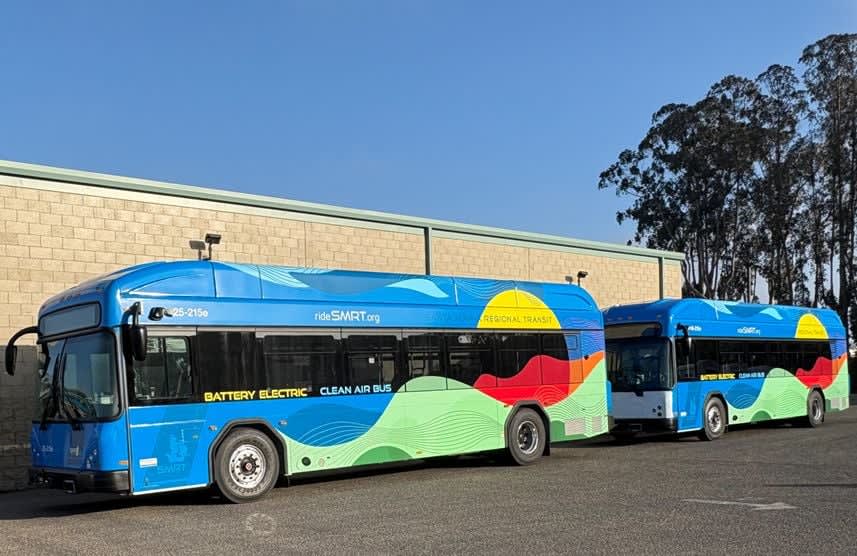
How Does This Station Advance California's Clean Transit Goals?
California has established some of the most ambitious zero-emission transit mandates in the world. The CARB ICT regulation sets a hard deadline: all transit buses must be zero-emission by 2040. Heavy-duty hydrogen infrastructure at scale is one of the key enablers for agencies operating large fleets on long routes. The SamTrans station is purpose-built for that mission. It is not a retail hydrogen station adapted for transit use. It is a dedicated, high-throughput facility designed from the ground up to fuel a fleet of up to 175 buses, day after day, with the reliability a public transit agency requires. The Center for Transportation and the Environment is providing independent technical support and third-party assessment throughout the project. CTE is a 501(c)(3) nonprofit with a track record in deploying clean transportation technologies across the U.S. Its involvement adds a layer of credibility and independent verification to the project's technical execution. If the CryoPump performs as specified at this scale, the SamTrans station becomes a replicable blueprint. Other California transit agencies and fleets across North America working toward similar zero-emission mandates will have a proven, commercially deployed model to reference.Bosch Rexroth and True Zero collaborate on CryoPump Hydrogen Filling Stations – showcasing the innovative cryopump technology for efficient, high-performance liquid hydrogen refueling that powers the first commercial deployment at the SamTrans station. (Official Bosch Rexroth US channel, ~Oct 2025)
What Does This Project Signal for Hydrogen in Heavy-Duty Transit?
Transit agencies worldwide are evaluating hydrogen fuel cell buses as they phase out diesel fleets. The SamTrans project gives the industry a concrete proof point: a station engineered for 175 buses, deploying next-generation compression technology, and cutting the two biggest cost drivers in liquid hydrogen fueling.
Bosch Rexroth is a global supplier of drive and control technologies operating across more than 80 countries. The company developed the CryoPump in partnership with hydrogen industry leaders in the U.S., with the explicit goal of addressing boiloff, reliability, and scalability gaps that have held back liquid hydrogen infrastructure deployment. The SamTrans contract is the commercial validation that work has been building toward.
The station will deliver 3.5 tons of hydrogen per day to up to 175 zero-emission buses serving more than 10 million SamTrans riders annually. That combination of scale, first-of-its-kind technology, and real-world transit deployment makes this one of the most significant hydrogen infrastructure milestones in North America in 2026.
Frequently Asked Questions
What is the FASTECH and Bosch Rexroth hydrogen station in California?
FASTECH and Bosch Rexroth have been contracted by the San Mateo County Transit District (SamTrans) to build what is expected to be the world's largest hydrogen refueling station dedicated to transit bus operations. The facility will support a fleet of up to 175 fuel cell electric buses, delivering up to 3.5 tons of hydrogen per day via four simultaneous dispensers in San Mateo County, California.
What is Bosch Rexroth's CryoPump and why does it matter?
The CryoPump is an electrohydraulically driven system that compresses liquid hydrogen directly to dispensing pressure, eliminating the need for buffer gas storage and complex valve manifolding. It nearly eliminates hydrogen boiloff and venting losses during the fueling process, reducing both waste and operating costs. The SamTrans project marks the first commercial deployment of this technology.
How many hydrogen buses has SamTrans ordered and why?
SamTrans ordered 108 hydrogen fuel cell Xcelsior CHARGE FC buses from New Flyer in 2024, the largest single fuel cell bus order in New Flyer's history. The agency is required by California's Air Resources Board Innovative Clean Transit regulation to transition its entire bus fleet to 100% zero-emission vehicles by 2040. The new station is designed to support a fleet of up to 175 fuel cell buses as SamTrans continues expanding toward that target.
San Mateo County is set to host the most capable hydrogen transit bus station ever built. With 3.5 tons of daily hydrogen output, a dispensing rate of 1,200 kilograms per hour, and the first commercial CryoPump deployment at its core, this contract marks a clear step forward for hydrogen in public transportation.
For ongoing coverage of hydrogen infrastructure, zero-emission transit, and clean fueling technology, subscribe to Decarbonfuse.com.
Subscribe to the newsletter
Daily decarbonization data and news delivered to your inbox
Follow the money flow of climate, technology, and energy investments to uncover new opportunities and jobs.
Latest issues
-
113 CCS Projects: What's Driving the Surge?
Inside This Issue 🏭 Global CCS Hits 113 Projects as Americas Lead Capacity 💰 We're Moving $2M+ to Climate Solutions 💧 China Launches World's First Semi-submersible Offshore Wind-to-hydrogen Platfo...
-
Why Is Wyoming Giving 650,000 Acres to Carbon Storage?
Inside This Issue 🪨 Inside Blm's 650,000-Acre Bet on Wyoming Carbon Storage 🏭 California Advances Carbon Capture and Removal Regulations Under SB 905 ⚡ Why a Japanese Power Giant Is Betting on Den...
-
Colorado Joins the 7-State CCS Permit Fast Lane
Inside This Issue ⚖️ Colorado Takes Over Class VI Permits: What Changes for CCS? 🏭 Hebei Shoulang Facility Using LanzaTech Technology Achieves World’s First ISCC EU RCF Certification for Ethanol P...
Company Announcements
-
China Launches World's First Semi-Submersible Offshore Wind-to-Hydrogen Platform
The world's first semi-submersible offshore wind-to-hydrogen platform has floated in Jiangmen, south China's Guangdong Province, opening a new avenue for the development and utilization of clean ma...
-
We’re Moving $2M+ to Climate Solutions
New companies, new ways to back existing ones, and every purchase built to pull in more capital We’re adding new companies to our portfolio and getting creative with how we put more money behind e...
-
Citi Closes $72 Million Carbon Removal-Linked Note to Support Applied Carbon Biochar Project
HIGHLIGHTS Citi structured an innovative $72 million carbon removal-linked note to provide upfront capital for Applied Carbon's biochar project, marking a first-of-its-kind "outcome bond" for ver...
-
New platform opens access to the same rigorous project evaluations trusted by the world's leading carbon removal procurement programs Today, Relae (formerly Carbon Direct) launched The Diligence C...