
MHI Successfully Demonstrates Production of Liquid Synthetic Fuels through an integrated Process Utilizing SOEC Co-Electrolysis and FT Synthesis
Published by Todd Bush on February 17, 2026
SOEC co-electrolysis simultaneously produces hydrogen and carbon monoxide, the feedstock for synthetic fuels, allowing for cost reductions by simplifying the process and increasing efficiency
Contributing to the decarbonization of aircraft, automobiles, ships, and city gas through the realization of carbon-neutral synthetic fuel production
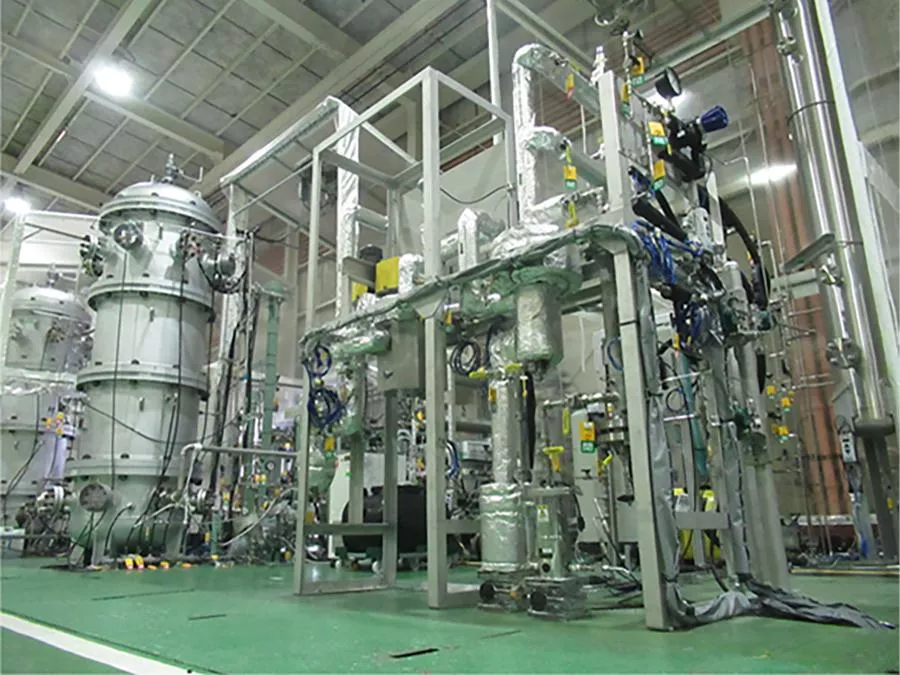
Demonstration test equipment integrating SOEC co-electrolysis and FT synthesis
Mitsubishi Heavy Industries, Ltd. (MHI) has conducted a demonstration of an integrated production process for synthesizing liquid fuels from carbon dioxide, water, and electricity, successfully producing liquid synthetic fuels through an integrated production system. The demonstration was conducted at MHI's Research & Innovation Center (Nagasaki District). In this process, SOEC co-electrolysis1 is employed to produce hydrogen and carbon monoxide, which are then used as the feedstock for production of liquid synthetic fuels using Fischer-Tropsch (FT) synthesis equipment.2 A chemical analysis of the synthesized liquid fuel confirmed that the demonstration had obtained components suitable for sustainable aviation fuel (SAF).
Co-electrolysis is a process for electrolysis of both water vapor and carbon dioxide, allowing for simultaneous production of hydrogen and carbon monoxide, which are the feedstock for synthetic fuels. In addition, MHI is utilizing its proprietary technology to develop a tubular type SOEC cell stack.3 Co-electrolysis in this SOEC cell stack is expected to simplify the process and improve economic efficiency through highly efficient electrolysis, supporting the production of cost-competitive synthetic fuels.
>> In Other News: Carbon Capture Technology Transforms Aluminium Production Costs and Efficiency
The International Civil Aviation Organization (ICAO) has set a target to achieve net-zero CO2 emissions in the international aviation sector by 2050.4 To meet this target, low-carbon fuels such as SAF and carbon credits are expected to account for more than 70% of the offsetting and reduction , so the demand for SAF is forecast to increase significantly worldwide. MHI aims to offer high value-added SAF production systems that combine SOEC co-electrolysis with existing FT synthesis processes.
In addition to SAF, the hydrogen and carbon monoxide produced by SOEC co-electrolysis can also be used as feedstock for carbon-neutral synthetic fuels for automobiles and ships (gasoline, diesel fuel, methanol, methane), as well as city gas (methane). The many applications of SOEC co-electrolysis make it a promising technology, with potential to offer a broad range of options for the realization of a decarbonized world.
Going forward, MHI will utilize the knowledge gained from this demonstration to establish and implement decarbonization technologies at an early stage, and contribute to the realization of a sustainable, carbon-neutral world.
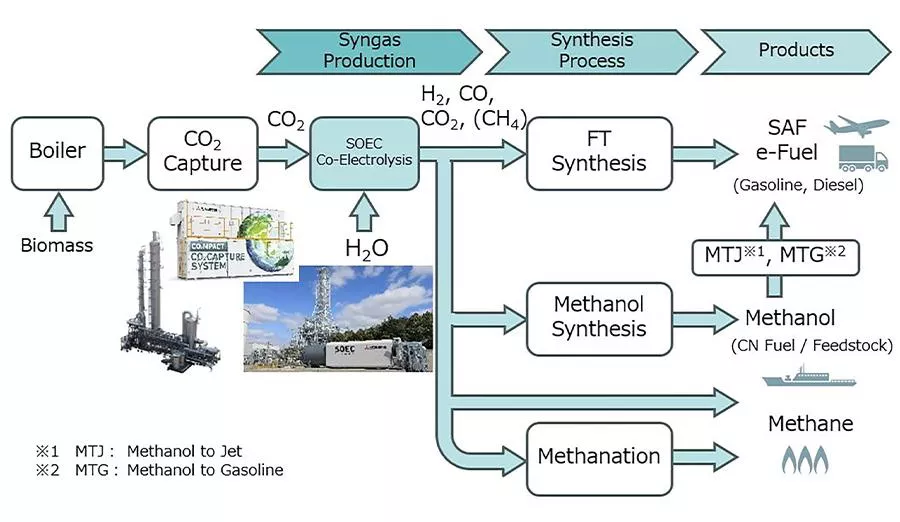
Processes and products derived from synthetic gas
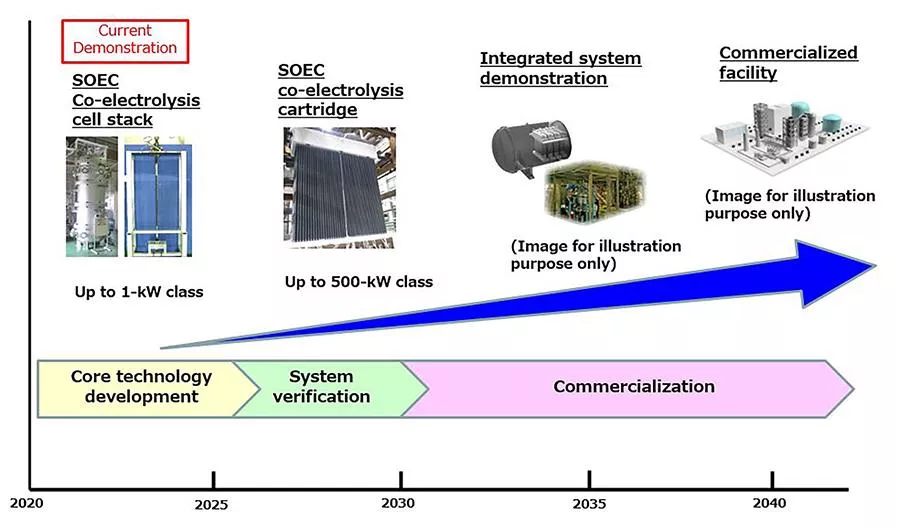
Road map for synthetic fuel production technology (SOEC co-electrolysis) development
1 "SOEC (Solid Oxide Electrolysis Cell) co-electrolysis" is a technology that uses solid oxides as electrolytes to simultaneously electrolyze carbon dioxide and water vapor at high temperatures. See the following Technical Review for details. https://www.mhi.com/technology/review/pdf/e623/e623040.pdf
1 "FT (Fischer-Tropsch) synthesis" is a technology to generate chemical reactions in hydrogen and carbon monoxide to produce liquid hydrocarbons. It is named after the German chemists Franz Fischer and Hans Tropsch.
1 Multiple ceramic functional membranes molded on the tubular surface. See the following Technical Review for details. https://www.mhi.com/technology/review/sites/g/files/jwhtju2326/files/tr/pdf/e621/e621030.pdf
1 For more information on the ICAO's goals, see the following. https://www.icao.int/environmental-protection/long-term-global-aspirational-goal-ltag-international-aviation
About MHI Group
Mitsubishi Heavy Industries (MHI) Group is one of the world’s leading industrial groups, spanning energy, logistics & infrastructure, industrial machinery, aerospace and defense. MHI Group combines cutting-edge technology with deep experience to deliver innovative, integrated solutions that help to realize a carbon neutral world, improve the quality of life and ensure a safer world. For more information, please visit www.mhi.com or follow our insights and stories on www.spectra.mhi.com.
Subscribe to the newsletter
Daily decarbonization data and news delivered to your inbox
Follow the money flow of climate, technology, and energy investments to uncover new opportunities and jobs.
Latest issues
-
113 CCS Projects: What's Driving the Surge?
Inside This Issue 🏭 Global CCS Hits 113 Projects as Americas Lead Capacity 💰 We're Moving $2M+ to Climate Solutions 💧 China Launches World's First Semi-submersible Offshore Wind-to-hydrogen Platfo...
-
Why Is Wyoming Giving 650,000 Acres to Carbon Storage?
Inside This Issue 🪨 Inside Blm's 650,000-Acre Bet on Wyoming Carbon Storage 🏭 California Advances Carbon Capture and Removal Regulations Under SB 905 ⚡ Why a Japanese Power Giant Is Betting on Den...
-
Colorado Joins the 7-State CCS Permit Fast Lane
Inside This Issue ⚖️ Colorado Takes Over Class VI Permits: What Changes for CCS? 🏭 Hebei Shoulang Facility Using LanzaTech Technology Achieves World’s First ISCC EU RCF Certification for Ethanol P...
Company Announcements
-
A consortium led by Novacium, together with Axel’One and AD-VENTA, has secured funding from the Defence Innovation Agency (AID) and the Directorate General of Armaments (DGA) under the RAPID progr...
-
Video: The Next Chapter https://youtu.be/LUIHqS35rMg Led by John Douglas, whose development experience includes the $8 billion Champlain Hudson Power Express, the collaboration brings major Nort...
-
Emvolon Raises $22 Million Funding Round to Launch Its Modular, Waste-to-Fuel Chemical Plants
Following its recent offtake agreement and increased commercial demand, Emvolon raises Series A and non-dilutive federal and state grants to launch first commercial system and adds industry growth ...
-
Puro.earth Expands DACCS Certification With CCS+ Methodologies
Puro.earth has published its CCS+ methodology documents, with direct air capture and geological storage (DACCS) as the first activity type implemented under its CCS+ Program. Puro.earth’s multi-pr...