
A report from conservation charity WWF in partnership with insurance giant Aviva highlights the important role of saltmarshes around the UK’s coasts in tackling climate change and protecting coastal communities.
The report reveals findings from a solar-powered “carbon flux tower”, funded by Aviva, which measures the exchange of key greenhouse gas carbon dioxide between the air and the saltmarsh on the Ribble Estuary, Lancashire.
It is a technique already used to monitor carbon capture and releases in other vital habitats such as woodlands and peatlands, but has now been adapted and applied to saltmarsh, with the Ribble Estuary producing the first results from a new network of towers.
>> In Other News: Trump Administration Terminates Award for Kentucky Carbon Capture Project
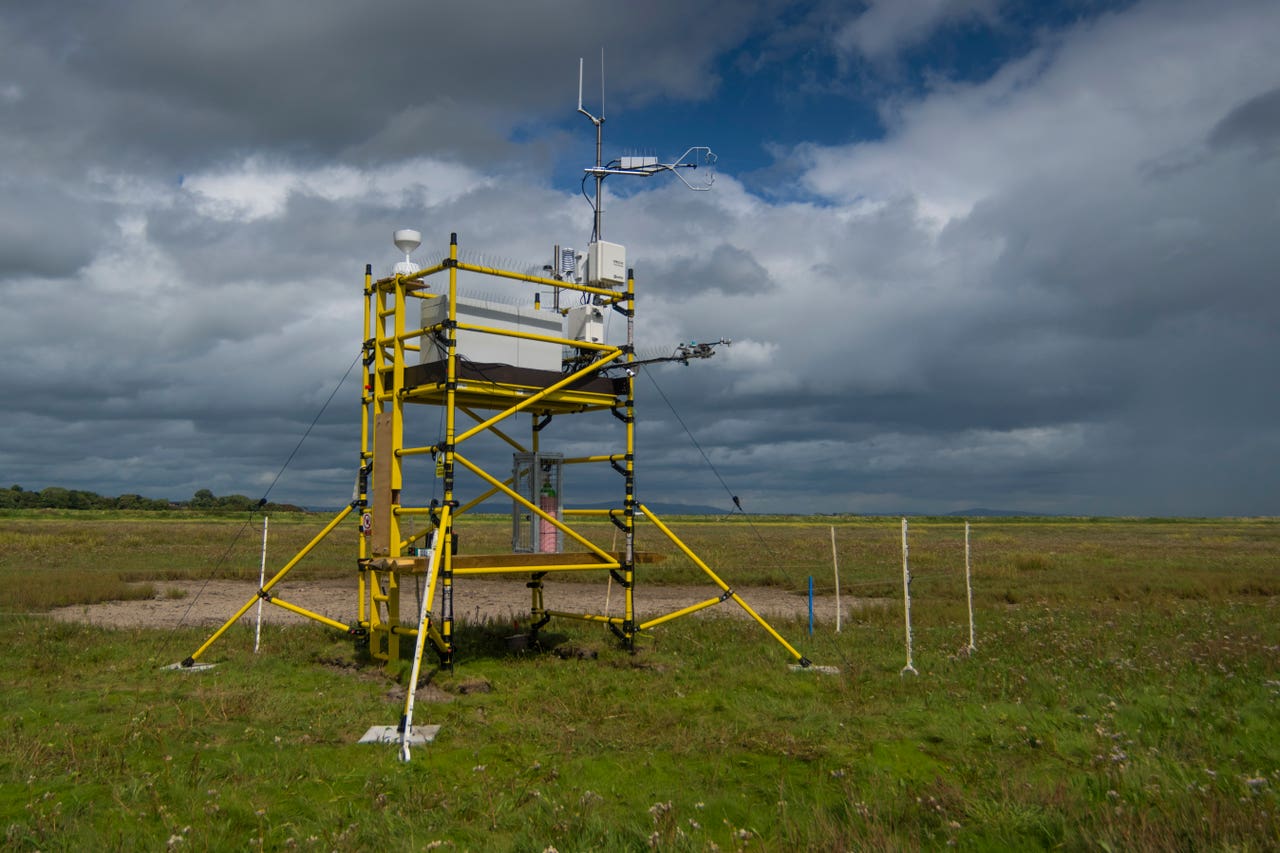
The carbon flux tower used to measure carbon dioxide levels on the Ribble Estuary (Andrew Parkinson/WWF UK/PA)
The data show the habitat is a significant “sink” or store of carbon dioxide, and while there are seasonal fluctuations in storage and release of the gas, the amount absorbed during the spring and summer outweighs what is released during the autumn and winter months.
WWF and Aviva are calling for saltmarshes to be included in the UK’s “greenhouse gas inventory” – the official record of the country’s emissions and removals which is used to track progress towards reducing climate pollution to zero overall, known as net zero.
The two organisations argue that including saltmarshes would improve national reporting and help unlock funding and policy supporting the habitat’s protection and restoration.
Experts warn that 85% of the UK’s saltmarshes, which provide wildlife habitat, carbon capture and natural flood management through slowing the movement of seawater inland, have been lost since the mid 19th century.
The remaining habitat plays a crucial role in shielding coasts from rising seas and storm surges, helping protect assets worth more than £200 billion in England and Wales, the report said.
But with climate change driving rising sea levels, the new report, produced in collaboration with the UK Centre for Ecology and Hydrology and the RSPB, assesses how the country’s remaining marshes are faring as waters rise.
To find out if saltmarshes were able to maintain their height above sea level, the conservationists set up a network of surface elevation tables, which measure how marsh height changes over time, across six UK saltmarshes.
The assessment found that generally saltmarshes were gaining height, although the results varied by region.

Saltmarshes are important habitats for wildlife, as well as carbon stores and protection for coastal communities (Rose Summers/WWF-UK/PA)
Marshes in areas such as Chichester and The Wash in East Anglia appear to be expanding, while those in North Norfolk and the Ribble are showing signs of struggling in the face of rising sea levels, the report said.
Tom Brook, ocean conservation specialist at WWF, said: "The results are in, and mud matters. Saltmarshes are powerful natural allies in the fight against climate change – storing carbon, protecting our coasts and supporting rich biodiversity.
"As extreme weather and rising sea levels put more people and places at risk, the case for protecting and restoring these habitats has never been stronger.
"This research adds to a growing body of evidence showing that saltmarshes are not just ecologically important but essential to building a resilient, net zero future."
Subscribe to the newsletter
Daily decarbonization data and news delivered to your inbox
Follow the money flow of climate, technology, and energy investments to uncover new opportunities and jobs.
Latest issues
-
Honeywell's Methanol-to-Jet Pathway Just Cleared Its Biggest Gate
Inside This Issue 🛫 Methanol-to-Jet Clears the ASTM Gate. What Changes Now? 🌿 InPlanet Selected as the Brazilian Supplier in Whirlpool Corporation's Durable Carbon Removal Portfolio 🧲 Climeworks A...
-
How Montana Renewables Cut $1B Out of Its SAF Budget
Inside This Issue 🌿 How Montana Renewables Cut MaxSAF Capex 89% 📋 IRS Issues Notice on 45Z Clean Fuel Production Tax Credit to Support Domestic Biofuel Production and American Agriculture 🌊 Natura...
-
Can Carba Really Remove Carbon Under $100?
Inside This Issue 🌬️ U.S. Bank Makes First Carbon Removal Purchase with Carba's Minnesota Biochar Project 🏭 Michigan's CCS Primacy Bid Could Reshape Great Lakes Industry 🏗️ Europe's Largest Carbo...
Company Announcements
-
In the largest rice methane offtake to date, Mitti Labs will deliver one million high-integrity credits to Google by 2030 BENGALURU, India and SAN FRANCISCO, Sept. 10, 2026 /PRNewswire/ -- Deep-t...
-
Climeworks Announces Key Performance Improvements at Mammoth
Over the past 18 months, technology upgrades have more than doubled CO₂ capture performance in upgraded collector containers while reducing operating costs by more than 50%. Zurich, Switzerland | ...
-
A team member at one of InPlanet’s partner farms inspects freshly harvested citrus fruit to assess its quality Remineralizer integrated into the soil following field application, beginning the enh...
-
Methanol-to-Jet Clears ASTM Gate. What Changes Now?
Methanol-to-jet has crossed a critical technical gate for commercial aviation fuel. ASTM D7566-26a, the active specification updated July 30, 2026, incorporates methanol into the Annex A5 alcohol-t...