
Nearly All Companies Will Miss Net Zero Goals Without At Least Doubling Rate of Carbon Emissions Reductions by 2030, Accenture Report Finds
Published by Todd Bush on November 2, 2022
NEW YORK--(BUSINESS WIRE)--While more than one-third (34%) of the world’s largest companies are now committed to Net Zero1, nearly all (93%) will fail to achieve their goals if they don’t at least double the pace of emissions reduction by 2030, according to a new report from Accenture (NYSE: ACN).
>> In Other News: The Open AI Energy Initiative Welcomes Seven New Members
Based on an analysis of commitments to emissions reduction and data from the 2000 largest public and private companies around the world, Accelerating Global Companies toward Net Zero by 2050 finds that growing energy price inflation and supply insecurity is pushing commitments out of reach, even as more companies in every region are setting clear and publicly visible decarbonization goals, with a record rise in the number of corporate targets validated by the Science-Based Targets initiative (SBTi) this year alone. Moreover, 84% of companies plan to increase investments in their sustainability initiatives before the end of 20222.
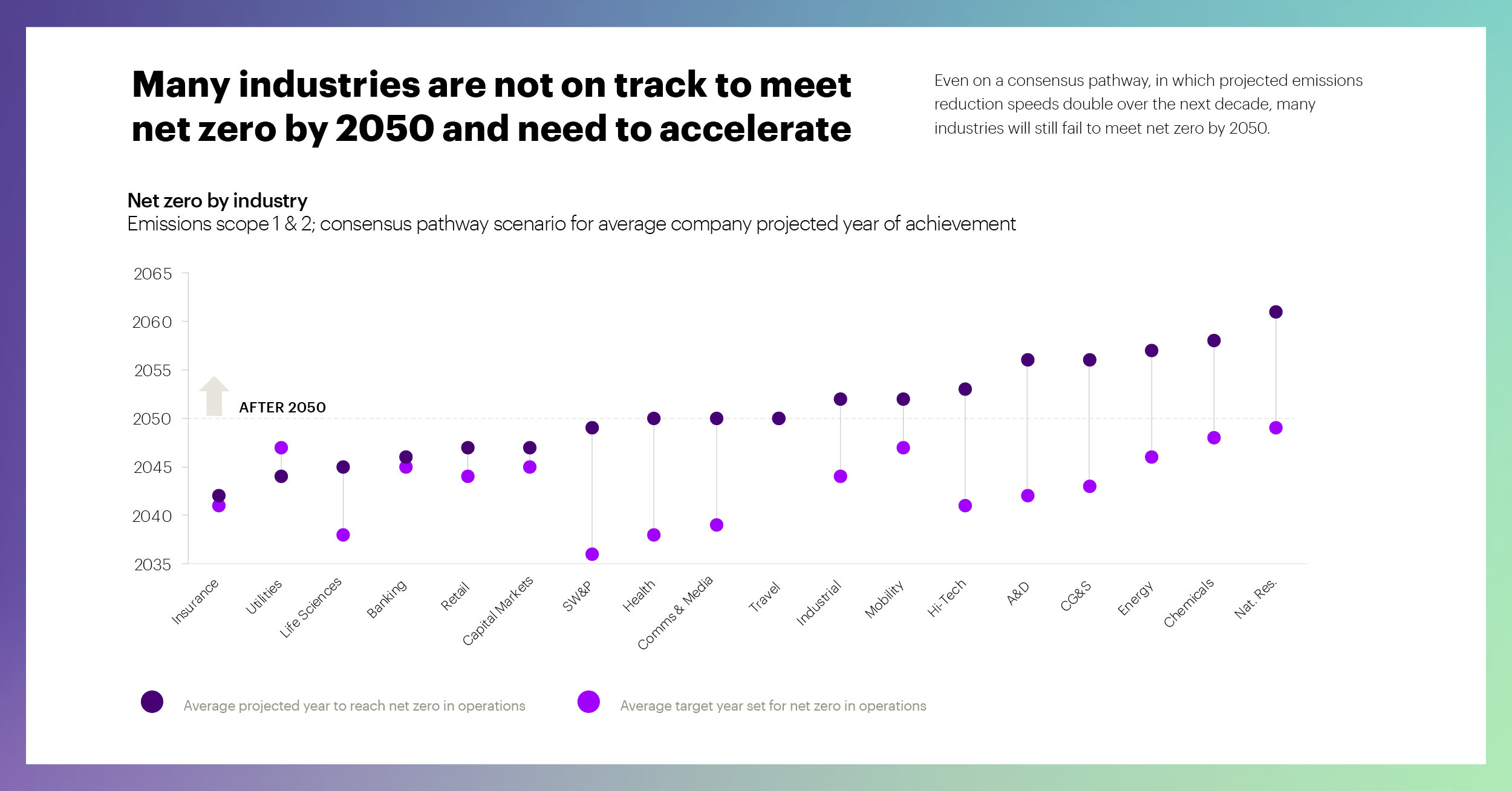
The report finds that acceleration toward net zero will require ‘carbon intelligence’ capabilities that enable organizations to control, improve and drive value-creation by embedding carbon and broader ESG intelligence into their core businesses and across their value chains. This includes integrating carbon, energy and other sustainability data and insights into financial and operational business information to help drive everyday decision-making.
“Amid global economic, political and environmental disruption, more companies than ever before have publicly committed to largely decarbonizing by around 2050. This heightened ambition is encouraging, but it is also clear that a steep acceleration of emission reductions is required,” said Jean-Marc Ollagnier, CEO of Accenture for Europe. “Maximizing value from mature technologies, such as digital and certain renewable energies, while accelerating the deployment of breakthrough solutions like hydrogen will be critical. Most importantly, reaching net zero will require urgent and profound transformations, as it is about embedding sustainability into everything organizations do, redefining their purpose, culture and business models.”
Despite the commitments made, however, only 7% of companies are on track to achieve their net zero targets for scope 1 and 2 emissions at the observed rates of change. Moving targets to 2050 increases that share just slightly to a mere 8%. Even in a scenario where companies accelerate emissions reduction to twice the current rates in the years to 2030 and then three times after – 59% would still fail by 2050; the deadline deemed necessary to avert the most catastrophic and irreversible impacts of climate change.
“To move at the speed and scale required by science and economics, it will be critical for businesses to develop multiple ‘carbon intelligence’ capabilities at the same time,” said Mauricio Bermudez-Neubauer, global lead for carbon strategy & intelligence at Accenture. “This means integrating decision-ready carbon data and insights across their systems and processes, enabling efficient use of financial and non-financial resources along with sound risk management in deploying the digital, biological and industrial technologies that will be necessary to attain net zero.”
A net zero transition must include every part of the business, and decarbonization can’t be done without a combination of digital and physical technology to make sense of carbon data and act on it with confidence.
“Now is perhaps a tougher time to be a CEO than any stage in the recent past, in particular, attempting to square the circle between sustainability commitments, inflationary and recessionary pressures and the need to deliver both shareholder and stakeholder value,” said Peter Lacy, Accenture’s global Sustainability Services lead and chief responsibility officer. “This report – while extremely worrying with regards to the delivery trajectory on net zero – shows a clear pathway for companies to create value and impact at a time when capital markets, governments and other organizations will create even more pressure to deliver on targets set through transparency, comparability and consistency.”
You can explore Accelerating Global Companies toward Net Zero by 2050 in Accenture Foresight, our new thought leadership app, which provides a personalized feed of all our latest reports, case studies, blogs, interactive data charts, podcasts and more. Visit: http://www.accenture.com/foresight.
About the Research
Accenture’s analysis takes stock of global corporate net zero targets. It shows how many of the world’s largest companies have announced net zero targets, in which year these companies aim to achieve net zero, and how they are positioned to meet these targets considering their track record of reducing greenhouse gas (i.e. “carbon”) emissions in the past 10 years. The sample was based on the Accenture Global 2000 (or “G2000”): an Accenture-developed list of the largest 2000 public and private companies in the world by revenue.
About Accenture
Accenture is a global professional services company with leading capabilities in digital, cloud and security. Combining unmatched experience and specialized skills across more than 40 industries, we offer Strategy and Consulting, Technology and Operations services and Accenture Song — all powered by the world’s largest network of Advanced Technology and Intelligent Operations centers. Our 721,000 people deliver on the promise of technology and human ingenuity every day, serving clients in more than 120 countries. We embrace the power of change to create value and shared success for our clients, people, shareholders, partners and communities. Visit us at https://accenture.com.
1 Defined as covering direct emissions from owned or controlled sources (Scope 1); indirect emissions from the generation of purchased electricity, steam, heating and cooling consumed by the reporting company (Scope 2); and all other indirect emissions that occur in a company's value chain (Scope 3).
2 Accenture CXO survey, June 2022.
Copyright © 2022 Accenture. All rights reserved. Accenture and its logo are trademarks of Accenture.
Subscribe to the newsletter
Daily decarbonization data and news delivered to your inbox
Follow the money flow of climate, technology, and energy investments to uncover new opportunities and jobs.
Latest issues
-
Can AirCapture’s Microwaves Cut DAC’s Energy Cost?
Inside This Issue 🌬️ Aircapture's Patented Microwave Direct Air Capture Technology Wins Tencent CarbonX 2.0 Award 🗾 Fujifilm, Tokyo Gas and TGES Agree to Supply City Gas Linked to Biomethane Produ...
-
380 MW of AI Power, Powered by Fuel Cells
Inside This Issue ⚡ FuelCell Energy and Fit Energy Announce Strategic Agreement for Up to 380 MW of Clean Power for Data Centers 🧭 China's Renewable Energy Mandates Set the Stage for Expanded Hydr...
-
250,000 Tonnes of CO2: One Shipping Deal
Inside This Issue 🚢 Fortescue and CMB.TECH Sign Milestone Agreement for 12 Ammonia Bulkers to Accelerate Zero-Emissions Shipping 🌱 Mati Carbon Hits New Bar for Carbon Removal Certification With Is...
Company Announcements
-
Canadian farmers and ethanol producers call on the Government to deliver on its Clean Fuel commitment and restore a level playing field for Canadian ethanol. OTTAWA, Ontario — Canada's Farms and F...
-
Coastal and Estuarine Carbon Removal Technique May Backfire When Pushed Too Far
Scientists investigating a proposed way to remove carbon dioxide from the atmosphere using seawater have found that adding too much alkalinity to neutralize acids can trigger chemical reactions tha...
-
Next Hydrogen Solutions Inc. (“Next Hydrogen” or the “Company”) (TSXV:NXH) is pleased to announce a collaboration agreement with Fusion Fuel Cycles Inc. (“FFC”) to demonstrate purpose-built electro...
-
Saskatchewan Conducts First Ever Crown Public Offering for Helium and Associated Gases
The Government of Saskatchewan is pleased to announce it launched and completed its first-ever helium and associated gases Crown public offering, held on June 22, 2026. This new process will streng...