
SWITCH Maritime Receives Design Basis Agreement From US Coast Guard For 150-Passenger Hydrogen Fuel Cell-Electric Ferry
Published by Todd Bush on October 21, 2026
NEW YORK, BUSINESS WIRE, SWITCH Maritime (Switch), a leading developer of zero-emission vessels, secured a Design Basis Agreement (DBA) with the United States Coast Guard (USCG) for the SWITCH-150, a 150-passenger hydrogen fuel cell-electric ferry. The SWITCH-150 is a zero-emission vessel that is designed to align with the performance and operating specification that ferry operators have come to expect from diesel vessels, but the only vessel emissions are water vapor.
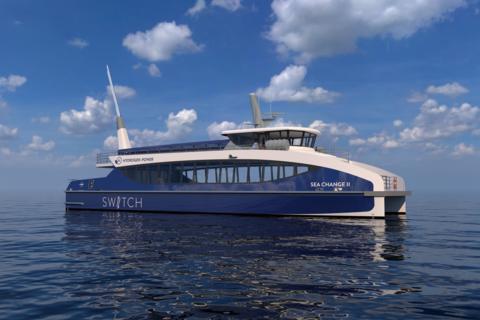
The SWITCH-150 is powered by an integrated hydrogen fuel cell-electric propulsion and hydrogen storage system that enables the vessel to perform high-frequency, high-intensity ferry operations like an existing diesel vessel. This means parallel service speeds, a daily bunkering schedule, and no need to increase dwell time or alter service to account for vessel charging. Further, the vessel requires no investment in costly and complicated shoreside charging infrastructure and power grid upgrades. Needing only mobile hydrogen refueling equipment, the SWITCH-150 can be seamlessly integrated into an ongoing ferry operation, rather than requiring scheduling changes or a system-wide reorientation, as would be required for a comparably specified battery-electric vessel. The SWITCH-150 was designed by global naval architecture firm, Incat Crowther.
>> In Other News: Hebei Shoulang Facility Using LanzaTech Technology Achieves World's First ISCC EU RCF Certification For Ethanol Produced From Steel Mill Waste Gases
The SWITCH-150 draws directly from the technical, regulatory, and operational framework set by Switch's first vessel, the Sea Change. The Sea Change is the first hydrogen fuel cell-electric ferry in the United States, which began passenger service in July 2024. The Sea Change received its DBA from the USCG in 2020 and its Certificate of Inspection (COI) in 2024, which cleared the vessel for commercial operation. The Sea Change was the first hydrogen fuel cell-electric vessel to successfully move through USCG's Alternative Design Basis Approval Process.
The USCG Subchapter T regulation, the set of rules and standards that governs the design, construction, and operation of passenger vessels with a capacity of 150-passengers or fewer, does not currently include guidance or regulation specifically tailored to hydrogen fuel cell-electric propulsion and hydrogen storage. To ensure that the SWITCH-150 design adhered to USCG standards, Switch and the vessel project team worked directly with USCG to build a regulatory framework that demonstrates sufficient equivalency in safety and risk mitigation. The International Maritime Organization (IMO) approved the Interim Guidelines for the Safety of Ships Using Hydrogen as Fuel in May 2026; these guidelines served as an important foundation for the DBA process for the SWITCH-150, adding more structure to the process while reducing time to approval.
Throughout the DBA process and the broader SWITCH-150 development process, Switch collaborated closely with Incat Crowther, which led vessel design and initial regulatory matrix development. The SWITCH-150 is the second vessel designed in partnership between Switch and Incat Crowther, after the Sea Change. In addition, Switch leveraged the critical contributions of a global team of expert partners, including hydrogen storage systems developer, Hexagon Purus; operational advisor, Hornblower Marine; hydrogen propulsion system design and safety specialist, LH2 Shipping; fuel cell system developer and manufacturer, PowerCell Group; and propulsion system integrator, SEAM.
The development of the SWITCH-150 has been supported by a $2 million grant from the New York State Energy Research and Development Authority (NYSERDA) to develop and demonstrate the first hydrogen-powered ferry in New York State. The grant was provided through NYSERDA's Advanced Fuels and Thermal Energy Research Program, which aims to accelerate deployment of commercially ready clean hydrogen technologies that reduce greenhouse gases across sectors.
The first SWITCH-150 is intended to operate in New York City, based at the Brooklyn Navy Yard. The New York application would utilize clean hydrogen, ensuring lowest-possible "well-to-wake" emissions. While this would be the first deployment, the SWITCH-150's propulsion system provides the performance, range, and flexibility to operate in a range of high-frequency commuter services throughout the United States.
"Signing the DBA with the Coast Guard is a critical milestone in advancing the development of the SWITCH-150. With the DBA in hand, Switch, our project team, and the USCG have a clear and defined framework that will inform vessel construction, commissioning, and ultimately operation," said Francisco Planells, the Director of the Newbuild Program at Switch. "We are now one step closer to deploying commercial-scale hydrogen-fueled vessels that will help operators to futureproof and decarbonize their fleets without operational compromise."
About SWITCH Maritime
Established in 2018, Switch is a developer of zero-emission maritime vessels that works with operators to futureproof and modernize their fleets without operational compromise. Switch serves as an operator’s full-service vessel development and integration partner, managing the risk and complexities associated with novel vessel and fuel supply chain development and operationalization through a comprehensive zero-emission package. Switch is the developer and manager of the Sea Change, the first hydrogen fuel cell-electric vessel in the United States. With the technical, regulatory, and operational lessons from the Sea Change as its foundation, Switch is scaling its zero-emission vessel platform to larger, faster, more energy-intensive maritime applications.
Subscribe to the newsletter
Daily decarbonization data and news delivered to your inbox
Follow the money flow of climate, technology, and energy investments to uncover new opportunities and jobs.
Latest issues
-
The US Hasn't Made Heavy Water Since 1982
Inside This Issue ⚛️ Aternium Completes FEED Studies for US Hydrogen, Heavy Water Project 🐄 Google, McKinsey Strike Brazil Carbon Removal Deal With Silvopasture Project 🔧 Cummins Selects Stargate ...
-
Why Colorado’s Koloma Has Japan’s Largest Utility Hooked
Inside This Issue ⚡ JERA Invests in Koloma to Explore Natural Hydrogen as a Future Low-Carbon Energy 🔬 New CATF Tool Provides Framework for Self-Assessment and Strengthening of Biomass Carbon Remo...
-
LNK Energies Targets $6.50 Hydrogen With No Federal Subsidies
Inside This Issue 🚛 MIT Startup Says It Can Turn Diesel Trucks Into Cheaper Hydrogen Haulers, See It at Disrupt 🏭 Baytown City Council Briefs: ExxonMobil Blue Hydrogen Agreement Approved 🌎 Colorad...
Company Announcements
-
NEW YORK, BUSINESS WIRE, SWITCH Maritime (Switch), a leading developer of zero-emission vessels, secured a Design Basis Agreement (DBA) with the United States Coast Guard (USCG) for the SWITCH-150,...
-
Hebei Shoulang New Energy Technology Co., Ltd. (“Hebei Shoulang”) in Tangshan, Hebei Province, China, has achieved ISCC EU Recycled Carbon Fuel (RCF) producer certification ISCC EU certification ver...
-
Toyota Achieves Heavy-Duty Hydrogen Truck Milestones
GARDENA, Calif. and PLANO, Texas , Oct. 20, 2026 /PRNewswire/ -- Toyota Motor North America's Hydrogen Headquarters (H2HQ) division is making steady progress in fueling improvements for heavy-duty ...
-
The parties intend to design hydrogen power into the Hendry County development's master plan before horizontal construction begins and to scale it with each phase of the build-out DELRAY BEACH, Fl...