
Syzygy Plasmonics Demonstrates Groundbreaking CO2-to-Fuel Solution with RTI International
Published by Todd Bush on May 14, 2024
Joint project delivers drop-in fuel that can be used in today's engines
HOUSTON, May 14, 2024 /PRNewswire/ -- Syzygy Plasmonics announced today that it along with the nonprofit research institute RTI International have successfully demonstrated an all-electric CO2-to-Fuel production pathway at RTI's facility in Research Triangle Park, North Carolina, USA. The new technology can significantly decarbonize transportation by converting two potent greenhouse gases, carbon dioxide (CO2) and methane (CH4), into low-carbon-intensity fuels that can be used to lower the carbon footprint of fossil-based jet fuel, diesel, and gasoline. The pilot project was sponsored by Equinor Ventures and Sumitomo Corporation of Americas (SCOA).
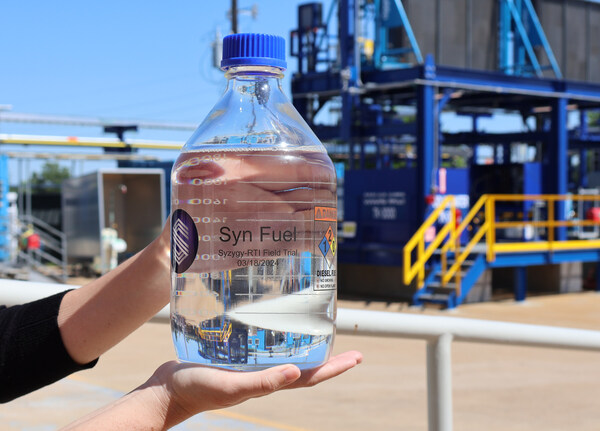
Bottle of Fischer-Tropsch crude produced from carbon dioxide and methane in a joint trial between Syzygy Plasmonics and RTI International with project sponsorship from Equinor Ventures and SCOA.
>> In Other News: Asahi Kasei Starts Operation of Multi-module Hydrogen Pilot Plant in Kawasaki
Results from this first-of-a-kind (FOAK) demonstration are providing data that will be used to design and build commercial CO2-to-Fuel plants enabled by Syzygy's technology. The project combined three of Syzygy's CO2-reforming reactors with RTI's Fischer-Tropsch (FT) pilot plant to produce FT crude, which can be further refined into aviation-grade kerosene. When fed by captured CO2 and combined with biogas, landfill gas, or renewable natural gas, this solution delivers extremely low-carbon and low-cost sustainable aviation fuel (SAF).
"This project showcases our ability to fight climate change by converting harmful greenhouse gases into fuel," said Syzygy CEO Trevor Best. "Our light-driven reactors produce valuable syngas at a ratio that is ideal for feeding Fischer-Tropsch units to produce SAF. Syzygy syngas can also be used to produce diesel, gasoline, and methanol. At scale, we're talking about significantly reducing and potentially eliminating the carbon intensity of shipping, trucking, and aviation. This is a major step toward quickly and cost effectively cutting emissions from the heavy-duty transport sector."
This project marks the successful integration of multiple Syzygy reactor cells in a multi-cell stack at a third-party site, demonstrating Syzygy's pathway for scaling its technology. At commercial scale, a typical Syzygy plant will consume nearly 200,000 tons of CO2 per year, the equivalent of taking 45,000 cars off the road.
"The results of this demonstration are encouraging and represent an important milestone in our collaboration with Syzygy," said Sameer Parvathikar, Ph.D., director of renewable energy and energy storage at RTI. "We are pleased to have played an impactful role in shaping this promising technology."
In addition to this CO2-to-Fuel demonstration, Syzygy's Ammonia e-Cracking™ technology has completed over 2000 hours of performance and optimization testing at its manufacturing facility in Houston, Texas. Syzygy is in negotiations to finalize a site and partners for building a commercial CO2-to-Fuel plant and is accepting orders for its Rigel™ photocatalytic reactor cells, which are designed for the commercial production of e-fuels and hydrogen.
About Syzygy Plasmonics
Syzygy Plasmonics is working to decarbonize the chemical industry, responsible for almost 20 percent of industrial CO2 emissions, by using light instead of combustion to drive chemical reactions. With Rigel™ reactor cells now ready to ship, Syzygy is commercializing a universal photocatalytic platform. When powered with renewable electricity, this tunable technology is designed to reduce both cost and emissions from many different chemical reactions. Starting with solutions designed to reform greenhouse gases into low-carbon fuels and produce low- and zero-emissions hydrogen, the company's mission is to create a world where chemicals, fuels, and fertilizer are low cost, carbon neutral, and accessible to everyone. For more information visit plasmonics.tech.
About RTI International
RTI International is an independent, nonprofit research institute dedicated to improving the human condition. Clients rely on us to answer questions that demand an objective and multidisciplinary approach—one that integrates expertise across the social and laboratory sciences, engineering, and international development. We believe in the promise of science, and we are inspired every day to deliver on that promise for the good of people, communities, and businesses around the world. For more information visit www.rti.org.
SOURCE Syzygy Plasmonics
Subscribe to the newsletter
Daily decarbonization data and news delivered to your inbox
Follow the money flow of climate, technology, and energy investments to uncover new opportunities and jobs.
Latest issues
-
Honeywell's Methanol-to-Jet Pathway Just Cleared Its Biggest Gate
Inside This Issue 🛫 Methanol-to-Jet Clears the ASTM Gate. What Changes Now? 🌿 InPlanet Selected as the Brazilian Supplier in Whirlpool Corporation's Durable Carbon Removal Portfolio 🧲 Climeworks A...
-
How Montana Renewables Cut $1B Out of Its SAF Budget
Inside This Issue 🌿 How Montana Renewables Cut MaxSAF Capex 89% 📋 IRS Issues Notice on 45Z Clean Fuel Production Tax Credit to Support Domestic Biofuel Production and American Agriculture 🌊 Natura...
-
Can Carba Really Remove Carbon Under $100?
Inside This Issue 🌬️ U.S. Bank Makes First Carbon Removal Purchase with Carba's Minnesota Biochar Project 🏭 Michigan's CCS Primacy Bid Could Reshape Great Lakes Industry 🏗️ Europe's Largest Carbo...
Company Announcements
-
In the largest rice methane offtake to date, Mitti Labs will deliver one million high-integrity credits to Google by 2030 BENGALURU, India and SAN FRANCISCO, Sept. 10, 2026 /PRNewswire/ -- Deep-t...
-
Climeworks Announces Key Performance Improvements at Mammoth
Over the past 18 months, technology upgrades have more than doubled CO₂ capture performance in upgraded collector containers while reducing operating costs by more than 50%. Zurich, Switzerland | ...
-
A team member at one of InPlanet’s partner farms inspects freshly harvested citrus fruit to assess its quality Remineralizer integrated into the soil following field application, beginning the enh...
-
Methanol-to-Jet Clears ASTM Gate. What Changes Now?
Methanol-to-jet has crossed a critical technical gate for commercial aviation fuel. ASTM D7566-26a, the active specification updated July 30, 2026, incorporates methanol into the Annex A5 alcohol-t...