
The study reveals how minerals first form inside tiny microfractures, slowing fluid flow but still allowing CO2 to transform into stable rock.
Capturing and storing carbon dioxide will be critical to avoiding the worst impacts of climate change.
Scientists estimate that billions of metric tons of industrial CO2 must be captured and locked away by the end of the century.
>> In Other News: LSB Industries' Arkansas CCS Well Puts Blue Ammonia Within Reach
One promising strategy involves storing the gas inside underground rocks. When CO2-rich fluid flows through certain rocks, chemical reactions can convert the carbon into solid minerals.
This process, known as carbon mineralization, could lock carbon underground for millions of years.
But scientists still want to understand how these rocks change during the process.
A new study from MIT offers a closer look. Researchers injected fluids into basalt rock samples and used X-ray imaging to watch how mineral formation reshaped the rock’s internal structure.
Their findings appear in the journal AGU Advances.
Basalt, a volcanic rock found in places such as Iceland and Hawaii, attracts strong interest for carbon storage. Fresh basalt contains many pores, fractures, and cracks that allow fluids to flow through it.
The rock also contains iron, calcium, and magnesium. When these elements react with CO2-rich fluid, they can form carbonate minerals such as calcite or dolomite.
Once carbon converts into these minerals, it effectively becomes stone.
Pilot projects already demonstrate the potential. In Iceland, the company CarbFix injects CO2-rich water into underground basalt formations.
The project has shown that more than 95 percent of injected CO2 can turn into minerals within two years.
However, researchers still question how the rocks themselves evolve as minerals accumulate.
“Most studies investigating carbon mineralization have focused on optimizing the geochemistry, but we wanted to know how mineralization would affect real reservoir rocks,” Peč says.
X-Rays Inside Basalt
To investigate, the MIT team conducted laboratory experiments using basalt samples collected in Iceland in 2023. They placed the rocks in a custom holder connected to tubes that pumped mineral-forming fluids through the samples.
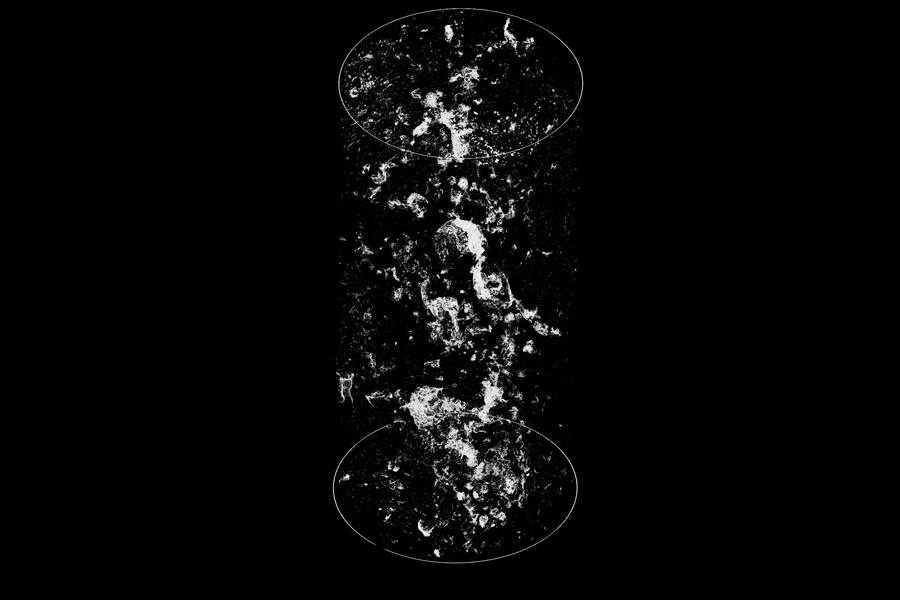
X-ray view of carbonate minerals deposited within a basalt core. Credit – Jonathan Simpson/MIT
Instead of replicating every stage of natural carbon storage, the researchers accelerated the mineralization step. They mixed two fluids that quickly produced carbonate minerals.
The team then ran the experiments inside an X-ray CT scanner. Similar scanners appear in hospitals for medical imaging.
The scanner captured detailed 3D images of the basalt over several days and weeks.
These images revealed how pores, cracks, and fractures changed as minerals formed inside the rock.
Flow Slows But Continues
The experiments showed that mineral formation quickly reduced the rock’s permeability. Permeability describes how easily fluids move through rock.
Porosity, however, changed far less. Even after long experiments, only about 5 percent of the original pore space filled with minerals.
“Our findings tell us that the minerals are initially forming in really small microcracks that connect the bigger pore spaces, and clogging up those spaces,” Simpson says.
“You don’t need much to clog up the tiny microfractures. But when you do clog them up, that really drops the permeability.”
Despite this drop, fluids still moved through the rock and continued forming minerals.
“If you were injecting CO2 into the Earth and saw a massive drop in permeability, some operators might think they clogged up the well,” Simpson says.
“But as this study shows, in some cases, it might not matter that much. As long as you maintain some flow rate, you could still form minerals and sequester carbon.”
Researchers say the findings may help engineers better design underground carbon storage systems.
“This study gives you information about what the rock does during this complex mineralization process, which could give you ideas of how to engineer it in your favor,” says study co-author Matėj Peč.
Subscribe to the newsletter
Daily decarbonization data and news delivered to your inbox
Follow the money flow of climate, technology, and energy investments to uncover new opportunities and jobs.
Latest issues
-
113 CCS Projects: What's Driving the Surge?
Inside This Issue 🏭 Global CCS Hits 113 Projects as Americas Lead Capacity 💰 We're Moving $2M+ to Climate Solutions 💧 China Launches World's First Semi-submersible Offshore Wind-to-hydrogen Platfo...
-
Why Is Wyoming Giving 650,000 Acres to Carbon Storage?
Inside This Issue 🪨 Inside Blm's 650,000-Acre Bet on Wyoming Carbon Storage 🏭 California Advances Carbon Capture and Removal Regulations Under SB 905 ⚡ Why a Japanese Power Giant Is Betting on Den...
-
Colorado Joins the 7-State CCS Permit Fast Lane
Inside This Issue ⚖️ Colorado Takes Over Class VI Permits: What Changes for CCS? 🏭 Hebei Shoulang Facility Using LanzaTech Technology Achieves World’s First ISCC EU RCF Certification for Ethanol P...
Company Announcements
-
A consortium led by Novacium, together with Axel’One and AD-VENTA, has secured funding from the Defence Innovation Agency (AID) and the Directorate General of Armaments (DGA) under the RAPID progr...
-
Video: The Next Chapter https://youtu.be/LUIHqS35rMg Led by John Douglas, whose development experience includes the $8 billion Champlain Hudson Power Express, the collaboration brings major Nort...
-
Emvolon Raises $22 Million Funding Round to Launch Its Modular, Waste-to-Fuel Chemical Plants
Following its recent offtake agreement and increased commercial demand, Emvolon raises Series A and non-dilutive federal and state grants to launch first commercial system and adds industry growth ...
-
Puro.earth Expands DACCS Certification With CCS+ Methodologies
Puro.earth has published its CCS+ methodology documents, with direct air capture and geological storage (DACCS) as the first activity type implemented under its CCS+ Program. Puro.earth’s multi-pr...