
ARC Bio has shown that biocrude made from Canadian forest residues can run through a refinery-style fluid catalytic cracking unit and yield jet-range fuel. Blended with HEFA SAF, that fraction met the key ASTM D1655 properties screened. The pilot points to a new SAF feedstock that can use refinery equipment already in place.
The joint venture announced the results on September 30, 2026, from Port-Cartier, Quebec. It's a pilot-scale milestone, and it gives Canada's forest sector a clear path toward aviation fuel markets.

Sawmill and forest operations generate the woody residues that ARC Bio converts into bio-oil and biocrude for jet fuel production.
What Did ARC Bio Demonstrate in Its Pilot?
ARC Bio converted forest-residue bio-oil into barrel-scale quantities of biocrude, then cracked it into a jet-range fuel fraction. The work used an FCC pilot unit that simulates commercial refinery operation.
ARC Bio is a Canadian joint venture between an affiliate of Bioénergie AE Côte-Nord Canada (Bioénergie AECN) and Alder Renewables. Bioénergie AECN runs a fast pyrolysis plant in Port-Cartier. Alder develops technology that upgrades bio-oil into refinery-ready biocrude.
The team upgraded Port-Cartier bio-oil into Alder Renewable Crude, known as ARC. Carbon-14 analysis then confirmed biogenic carbon from the wood feedstock in the resulting fuel products.
The jet-range cut was blended with HEFA SAF made from fats, oils, and greases. That blend met the key ASTM D1655 fuel-property specifications evaluated in the screening.
Key Facts
- Announced: September 30, 2026, in Port-Cartier, Quebec
- Partners: an affiliate of Bioénergie AECN and Alder Renewables
- Feedstock: Canadian forest residues converted by fast pyrolysis
- Port-Cartier capacity: 40 million litres of bio-oil per year
- Test: FCC pilot unit simulating commercial refinery operation
- Result: the HEFA SAF blend met the key ASTM D1655 properties screened
- Verification: carbon-14 analysis confirmed biogenic carbon
- Backer: Boeing, which is investing CAD $10 million in the partners' Project Avance
- Status: the pathway is still under ASTM evaluation
>> In Other News: World Habitat Day: Pacifico Mexinol Project and Its Low-Carbon Methanol Technology Presented in Mexico City
How Does Forest Residue Become Jet Fuel?
The pathway turns bulky wood waste into an energy-dense, transportable biocrude before refining. It runs in five steps.
- Forest residues are gathered as feedstock.
- Fast pyrolysis at Port-Cartier converts the residues into bio-oil.
- Alder's process upgrades the bio-oil into ARC biocrude.
- An FCC unit co-processes ARC alongside conventional refinery feed.
- The jet-range fraction is isolated and blended with HEFA SAF.
Port-Cartier is North America's largest fast pyrolysis bio-oil facility using wood residues. The plant has an annual production capacity of 40 million litres of bio-oil, according to ARC Bio.

The ARC Bio pathway moves woody residues through pyrolysis, upgrading, and refinery co-processing to produce a jet-range fuel fraction.
Because the biocrude travels well, scattered forest operations can feed large central refineries. That link between distributed residues and big fuel plants sits at the core of ARC Bio's model.
Why Does Refinery Co-Processing Matter for SAF?
Co-processing lets renewable biocrude share refinery units that already make transportation fuels. Refineries around the world use FCC units, so the approach can reduce the new infrastructure that fresh feedstocks need.
Some pretreatment, upgrading, and refinery adjustments may still be needed. Even so, the model aims to avoid building an entirely new standalone refinery for each project.

"The significance of this demonstration is not simply that we produced a renewable jet-range fuel. We demonstrated a pathway connecting Canadian forest residues with refinery infrastructure already operating at commercial scale. That creates the potential for a scalable, capital-efficient route to bring forest-derived renewable carbon into aviation fuel markets."
Derek Vardon, CEO, Alder Renewables
Global SAF output reached 1.9 million tonnes in 2025, or 0.6% of jet fuel use, according to IATA. New feedstock routes help that supply keep growing.
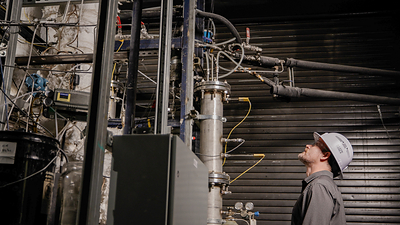
ARC Bio distributed this FCC pilot unit image with its September 30, 2026 announcement of forest-residue biocrude co-processing.
IATA expects HEFA and co-processing to deliver 84% of SAF output from 2030 renewable fuel capacity, GreenAir News reported. That puts co-processing near the center of SAF growth this decade.
How Does Forest Residue SAF Compare with HEFA?
HEFA leads commercial SAF output today, and it draws on fats, oils, and greases. Forest residues come from a completely different biomass pool, which widens the supply base.
HEFA has scaled through producers like Calumet's Montana renewable fuels refinery and technologies such as Honeywell's Ecofining process. Other routes keep adding options, from a planned on-airport alcohol-to-jet plant to planned wood-waste SAF projects in Louisiana and methane-derived SAF platforms.
| SAF Pathway | Typical Feedstock | Infrastructure Route | Commercial Maturity |
|---|---|---|---|
| HEFA | Fats, oils, used cooking oil | Dedicated or refinery-linked processing | Commercial |
| Alcohol-to-jet | Ethanol and other alcohols | Dedicated conversion facilities | Early commercial |
| Fischer-Tropsch | Biomass, wastes, syngas | Gasification plus FT conversion | Approved, limited deployment |
| Pyrolysis biocrude co-processing | Woody biomass, forest residues | Biocrude processed in refinery equipment | Under development and evaluation |
Each pathway fills a different niche. ARC Bio's route adds woody biomass to the mix while reusing refinery assets.
What Does This Mean for Canada's Forest Sector?
The demonstration gives Canadian wood residues a potential new market in aviation fuel. ARC Bio says higher-value uses for residues can strengthen forest-sector economics as traditional markets shift.

"Canada has the biomass feedstock, the forest sector expertise, the industrial capability and the refining infrastructure to build an important new clean fuel value chain."
Serge Mercier, President, Bioénergie AECN
ARC Bio also sees value in residues from forest management and wildfire-risk reduction, where supply chains can be established. Bioénergie AECN is a joint venture of Arbec Forest Products and Groupe Rémabec.
>> RELATED: Drax and Pathway Energy Partner to Launch New US SAF Plants
Boeing provided financial support for the demonstration. The aerospace company is investing CAD $10 million in the partners' Project Avance SAF initiative in Port-Cartier, according to Alder Renewables.
Canada's Clean Fuel Regulations set up a credit market for gasoline and diesel suppliers. Low-carbon fuel producers, including SAF producers, can opt in as voluntary credit creators. That framework adds to Canada's growing decarbonization investment pipeline.
Where Does ASTM Approval Stand?
The ARC Bio pathway is still moving through ASTM qualification. The International Civil Aviation Organization (ICAO) lists Alder's biomass pyrolysis route among processes under ASTM International evaluation.
ICAO counted 11 approved SAF conversion processes, with 11 more under evaluation, as of July 2023. The pilot results add data toward approval. They don't yet represent a fully certified pathway.
Blend limits under ASTM D1655 vary by approved pathway. Any co-processing limit for ARC Bio's route will depend on that qualification process.
What Happens Next for ARC Bio?
ARC Bio will generate more refinery-relevant data to support larger-scale trials. Its roadmap points to a first-of-a-kind Canadian commercial project combining forest-residue conversion, biocrude production, and refinery integration.
ARC Bio director Julien Lampron told SustainableBiz that the next phase would involve a refinery co-located at a Bioénergie pyrolysis site. He added that the company ultimately wants pyrolysis plants across Canada using forestry residues.
10 News reports on an Adelaide project that converts forest waste into fuel for aviation, a feedstock route similar to ARC Bio’s plan to turn Canadian wood residues into jet-range fuel.
Demand signals keep building abroad, too. SAF made up 1.1 million tonnes, or 2.8%, of aviation fuel supplied at EU airports in 2025, according to the EASA ReFuelEU Aviation report.
Frequently Asked Questions
Is ARC Bio's forest-residue SAF certified?
Not yet. The pilot blend met the key ASTM D1655 properties screened, and the pathway remains under ASTM evaluation.
What is fluid catalytic cracking?
Fluid catalytic cracking, or FCC, is a refinery process widely used worldwide to make transportation fuel components. ARC Bio fed its biocrude into an FCC pilot unit that simulates commercial operation.
How much SAF does the world produce today?
IATA estimates global SAF production reached 1.9 million tonnes in 2025. New feedstocks like forest residues could help that volume keep growing.
From Sawmill Waste to Runway Fuel
ARC Bio has shown that wood residues and refinery units can work together on jet fuel. With 40 million litres of yearly bio-oil capacity at Port-Cartier and Boeing's backing, the next trials could shape Canada's first commercial forest-residue SAF project.
For ongoing coverage of carbon removal, BECCS, and corporate CDR procurement, subscribe to Decarbonfuse.com.
Subscribe to the newsletter
Daily decarbonization data and news delivered to your inbox
Follow the money flow of climate, technology, and energy investments to uncover new opportunities and jobs.
Latest issues
-
Quebec Wood Waste Just Became Jet Fuel
Inside This Issue 🌲 ARC Bio Tests a Refinery Shortcut to Forest-Based SAF 💧 Scientists Just Found a New Way to Make Hydrogen from Water 🤝 How Channel Partnerships Are Helping More Organizations Ta...
-
How Vaulted Deep Turned Offtakes Into $35M Debt
Inside This Issue 🏦 How Carbon Removal Offtakes Are Starting to Unlock Commercial Debt 🌉 California Opens the Door to a Three-Way Carbon Market 🧪 New Material Developed at Oregon State Provides Bo...
-
Canada Wants Foreign Buyers for Its Carbon Removals
Inside This Issue 🍁 Canada Explores Article 6 Path to Global Carbon Buyers 🌲 ARC Bio Demonstrates Canadian Forest Residue Pathway to Sustainable Aviation Fuel 🌾 Business, Forestry and Agriculture ...
Company Announcements
-
MEXICO CITY--BUSINESS WIRE--In the framework of today's World Habitat Day, here is an invitation to reflect on building more sustainable communities, where Mexico is moving firmly toward the energy...
-
Vortex Energy Commissions Hydrogen and Helium Study at Robinsons River Salt Project
Desktop Study Will Use Existing Geological, Geophysical and Well Data to Assess Natural Hydrogen and Helium Potential VANCOUVER, British Columbia, Oct. 05, 2026 (GLOBE NEWSWIRE) -- Vortex Energy C...
-
How Channel Partnerships Are Helping More Organizations Take Action
Organizations of all sizes are looking for credible ways to address their carbon emissions. But to help high-integrity Carbon Dioxide Removal (CDR) solutions reach small-to-medium-sized organizatio...
-
Uniper signs capacity reservation agreement for future SAF supply from Syzygy Plasmonics' NovaSAF™ platform This agreement reflects growing market momentum in biogas to SAF technology and provides...