
Atlantic Biomass, LLC Announces Duel Pathway System to Affordably Produce Sustainable Aviation Fuels (SAF) and Renewable Bioproducts
Published by Todd Bush on February 26, 2026
Feedstocks are Perennial Grasses and other Renewable Biomass Sources
FREDERICK, Md., Feb. 18, 2026 /PRNewswire/ -- Do you know why passenger and freight planes are not using renewable biofuel? It's a simple reason - it costs too much.
"Converting stems and leaves from sustainable biomass into high-energy liquid fuels is not easy," says Bob Kozak, President, Atlantic Biomass. "And right now it's expensive."
>> In Other News: QMET Applauds QIMC Hydrogen Discovery at West Advocate; Strengthens Geological Case for QMET's Upcoming Nova Scotia Drill Campaign
Atlantic Biomass Dual Pathway System
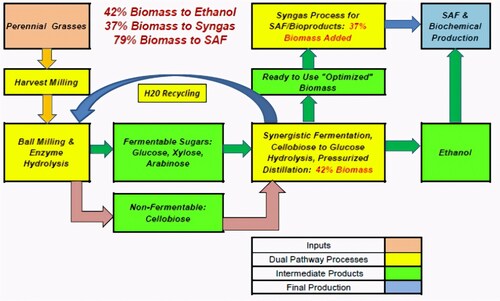
So, Atlantic Biomass, LLC and our partners; The Ohio State University and Hood College, with funding assistance from Phase I of the U.S. Department of Energy Small Business Technology Transfer (STTR) program* and the Maryland Energy Innovation Institute (MEII), took apart the whole biomass-to-biofuel system to find an affordable way forward. "We started by testing each process. Found out the limits and hidden benefits. It was hard work," Kozak continued.
"Instead of focusing on individual steps, we decided to look at biofuel production as a complex system that needed to be understood," Kozak pointed out. "We looked for feedback loops and possibilities for multiprocessing. We found some that would lower costs and we put it all back together in a simplified Dual Pathway system."
How does it work?
The Atlantic Biomass integrated biomass-ethanol-SAF process, which was the original focus of our work, can simultaneously be used to produce a high purity SAF syngas feedstock. This creates a Dual Pathway system that can nearly double biomass to SAF yields from about 42 percent to 79 percent without adding biomass cleaning, syngas scrubbing, or other processing costs.
Four key discoveries power the Dual Pathway system.
Simultaneous ball milling and enzyme hydrolysis eliminates the need for costly thermo and chemical pretreatment to convert carbohydrates to sugars.
Enzyme activity started during ball milling continues downstream. Combined with fermentation, it is able to remove inhibitions that prevent the conversion of a key biomass intermediate, cellobiose, to fermentable glucose without increasing processing costs.
The combined processes required for ethanol production also produce a low impurity syngas feedstock. This overcomes purity and heterogeneous compositions issues that currently limit the economics of using harvested biomass for syngas production.
Increasing the ratio of the diameter of a ball milling vessel to the length of perennial grass biomass to above a discovered value, converts most of the input biomass to a slurry containing fermentable sugars in a 24 hour cycle.
Use of the Dual Pathway System
The U.S. Department of Energy 2023 Billion Ton Report shows that just in the US, perennial grasses have the potential to produce 284-535 million tons/year of biofuel biomass ready for processing. By partnering with existing ethanol and syngas based SAF installations, our system would be able to produce over 1 million barrels/day of affordable and sustainable renewable jetfuel from these grasses. "That would be just about enough to fuel every US commercial and freighter flight with US produced renewables. Think what a difference that could make," said Kozak.
In addition, portable versions of the Dual Pathway system can be forward deployed to key indigenous grass growing regions worldwide to produce ethanol and syngas to feed into European or Asian SAF production facilities. "We think it would bring sustainable economic and environmental benefits to countries around the Pacific and well as central Europe and Asia," continued Kozak. "We look forward to the opportunity of putting together joint ventures with SAF and agricultural organizations throughout the world."
Sustainable and Profitable Economics of the Dual Pathway System
The combination of the ethanol-to-SAF and syngas-to-SAF pathways in one system offers the cost-saving economics of vertical integration.
Atlantic Biomass Dual Pathway System
This business arrangement, pioneered by John D. Rockefeller, Founder, Standard Oil, would produce maximum synergy savings by fine-tuning enzyme loads, processing times, and other production parameters without worrying about intermediate conditions or transfer fees. "The scientists and engineers working with the system will be able to see it as one continuous stream. They won't have to worry about filling out forms or waiting for permission to test possible improvements," stated Kozak.
Estimated Dual Pathway Costs and Revenues
The Dual Pathway system will maximize profit potential by using the costs of ethanol-to-SAF production; ball milling, fermentation, distillation, to also produce the high-purity feedstock needed for syngas production. This provides a major profit increase over stand-alone biomass-ethanol-SAF systems as shown in the following table. Estimates in this table are presented on a per acre basis. This allows for easier comparisons of projects based on available acreage.
Compared to only ethanol to SAF
Are You Ready for Take-Off?
An illustrated version of this press release as well as detailed R&D results and additional information is available from Atlantic Biomass, LLC.
About Atlantic Biomass, LLC
Atlantic Biomass, LLC, a small business located in Frederick, Maryland is focused on the development and commercialization of proprietary enzymatic-based biomass "deconstruction" processes. These processes allow the use of low-cost, non-food biomass as feedstocks for renewable sustainable biofuels and bioproducts. Processes developed convert perennial grasses, hemp biomass, and sugar beet pulp into the building blocks for biofuels and other bioproducts, as well as dandelions for rubber.
- Note: Unfortunately the DOE SBIR/STTR program no longer exists. It was abolished in FY 2026 DOE appropriations
SOURCE Atlantic Biomass, LLC
Subscribe to the newsletter
Daily decarbonization data and news delivered to your inbox
Follow the money flow of climate, technology, and energy investments to uncover new opportunities and jobs.
Latest issues
-
113 CCS Projects: What's Driving the Surge?
Inside This Issue 🏭 Global CCS Hits 113 Projects as Americas Lead Capacity 💰 We're Moving $2M+ to Climate Solutions 💧 China Launches World's First Semi-submersible Offshore Wind-to-hydrogen Platfo...
-
Why Is Wyoming Giving 650,000 Acres to Carbon Storage?
Inside This Issue 🪨 Inside Blm's 650,000-Acre Bet on Wyoming Carbon Storage 🏭 California Advances Carbon Capture and Removal Regulations Under SB 905 ⚡ Why a Japanese Power Giant Is Betting on Den...
-
Colorado Joins the 7-State CCS Permit Fast Lane
Inside This Issue ⚖️ Colorado Takes Over Class VI Permits: What Changes for CCS? 🏭 Hebei Shoulang Facility Using LanzaTech Technology Achieves World’s First ISCC EU RCF Certification for Ethanol P...
Company Announcements
-
A consortium led by Novacium, together with Axel’One and AD-VENTA, has secured funding from the Defence Innovation Agency (AID) and the Directorate General of Armaments (DGA) under the RAPID progr...
-
Video: The Next Chapter https://youtu.be/LUIHqS35rMg Led by John Douglas, whose development experience includes the $8 billion Champlain Hudson Power Express, the collaboration brings major Nort...
-
Emvolon Raises $22 Million Funding Round to Launch Its Modular, Waste-to-Fuel Chemical Plants
Following its recent offtake agreement and increased commercial demand, Emvolon raises Series A and non-dilutive federal and state grants to launch first commercial system and adds industry growth ...
-
Puro.earth Expands DACCS Certification With CCS+ Methodologies
Puro.earth has published its CCS+ methodology documents, with direct air capture and geological storage (DACCS) as the first activity type implemented under its CCS+ Program. Puro.earth’s multi-pr...