
H2SITE’s AMMONIA to H2POWER Technology Receives Approval in Principle From Lloyd’s Register
Published by Todd Bush on April 29, 2024
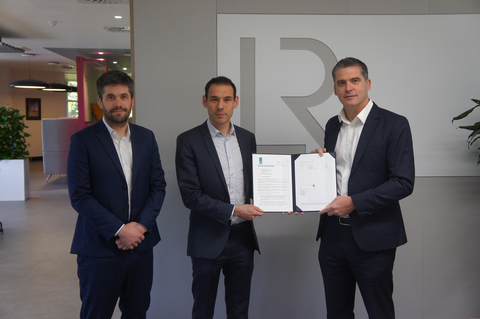
H2SITE’s AMMONIA to H2POWER technology for ammonia cracking on-board has received Approval in Principle (AiP) from Lloyd’s Register (LR).
The technology is an onboard containerised solution that produces fuel-cell-quality hydrogen using ammonia. This hydrogen can then be utilised by hydrogen fuel cells that can contribute to the vessel’s electrical power, or the hydrogen could be consumed directly in an internal combustion engine (ICE).
April 29, 2024 02:30 AM Eastern Daylight Time
LOIU, Spain--Ammonia cracking is gaining momentum as a potential hydrogen carrier for onboard applications and this system is based on H2SITE’s hydrogen-selective membranes that overcome the thermodynamic limitations of the ammonia cracking reaction by recovering hydrogen continuously and resulting in virtually complete ammonia conversion and higher efficiencies at lower temperatures, reducing overall energy consumption and footprint.
>> In Other News: Zefiro Registers its First Methane Reduction Project on American Carbon Registry
In awarding the AIP, the design and arrangement evaluation included an overall examination of fundamental aspects of the design and compliance with LR’s Rules and Regulations for the Classification of Ships using Gases or other Low-flashpoint Fuels. A preliminary appraisal of rules was undertaken, followed by a risk assessment conducted to ensure that the risks arising from the use of ammonia and hydrogen are addressed according to LR’s ShipRight Procedure for Risk-Based Certification (RBC).
H2SITE operationally demonstrated its ammonia to hydrogen power technology last November when the Zumaia Offshore’s Bertha B vessel carried onboard AMMONIA to H2POWER technology, validating its performance in actual offshore conditions.
"We are proud to have achieved this milestone, as it validates the design and safety of our onboard ammonia cracking technology for decarbonizing maritime applications based on membrane reactors. Having commissioned our first cracker and fuel cell unit last year aboard the supply vessel Bertha B, we are currently scaling up the technology and designing MW-scale units." according to Jose Medrano Technical Director at H2SITE.
These AMMONIA to H2POWER systems will be integrated with both propulsion systems and auxiliary power units to serve a range of vessels, from offshore platforms to tankers and gas carriers.
Mark Darley, Chief Operations Officer, Lloyd’s Register added: “H2SITE's AMMONIA to H2POWER technology represents an exciting opportunity for shipowners to convert ammonia, and other feedstocks such as methanol, to hydrogen onboard their vessels without using additional gas separation technology”.
“We are pleased to award the AiP for this novel solution, and we remain dedicated to working with the maritime value chain to provide zero-emission power solutions that can contribute towards a greener, more sustainable future.”
About H2SITE
H2SITE was created in 2020 and has an exclusive technology of reactors and separators for the conversion of different feedstocks into hydrogen, among which are ammonia, methanol, or synthetic gas, in addition to the separation of hydrogen from gaseous mixtures in low concentration for applications in salt caverns or geologic hydrogen.
About Lloyd’s Register
Trusted maritime advisers, partnering with clients to drive performance across the ocean economy. Lloyd’s Register (LR) is a global professional services group specialising in marine engineering and technology. With a heritage going back more than 260 years to the establishment of the world’s first marine classification society, LR is dedicated to setting and improving standards for the safety of ships.
Today we are a leading provider of classification and compliance services to the marine and offshore industries, helping our clients design, construct and operate their assets to accepted levels of safety and environmental compliance. We also provide advice, support and solutions on fleet performance, fleet optimisation and voyage optimisation, enhancing our clients’ digital capabilities. Our digital solutions are relied upon by more than 20,000 vessels.
In the race to zero emissions, our research, technical expertise and industry-firsts are supporting a safe, sustainable maritime energy transition.
Lloyd’s Register Group is wholly owned by the Lloyd’s Register Foundation, a politically and financially independent global charity that promotes safety and education.
Find out more lr.org
Subscribe to the newsletter
Daily decarbonization data and news delivered to your inbox
Follow the money flow of climate, technology, and energy investments to uncover new opportunities and jobs.
Latest issues
-
Honeywell's Methanol-to-Jet Pathway Just Cleared Its Biggest Gate
Inside This Issue 🛫 Methanol-to-Jet Clears the ASTM Gate. What Changes Now? 🌿 InPlanet Selected as the Brazilian Supplier in Whirlpool Corporation's Durable Carbon Removal Portfolio 🧲 Climeworks A...
-
How Montana Renewables Cut $1B Out of Its SAF Budget
Inside This Issue 🌿 How Montana Renewables Cut MaxSAF Capex 89% 📋 IRS Issues Notice on 45Z Clean Fuel Production Tax Credit to Support Domestic Biofuel Production and American Agriculture 🌊 Natura...
-
Can Carba Really Remove Carbon Under $100?
Inside This Issue 🌬️ U.S. Bank Makes First Carbon Removal Purchase with Carba's Minnesota Biochar Project 🏭 Michigan's CCS Primacy Bid Could Reshape Great Lakes Industry 🏗️ Europe's Largest Carbo...
Company Announcements
-
In the largest rice methane offtake to date, Mitti Labs will deliver one million high-integrity credits to Google by 2030 BENGALURU, India and SAN FRANCISCO, Sept. 10, 2026 /PRNewswire/ -- Deep-t...
-
Climeworks Announces Key Performance Improvements at Mammoth
Over the past 18 months, technology upgrades have more than doubled CO₂ capture performance in upgraded collector containers while reducing operating costs by more than 50%. Zurich, Switzerland | ...
-
A team member at one of InPlanet’s partner farms inspects freshly harvested citrus fruit to assess its quality Remineralizer integrated into the soil following field application, beginning the enh...
-
Methanol-to-Jet Clears ASTM Gate. What Changes Now?
Methanol-to-jet has crossed a critical technical gate for commercial aviation fuel. ASTM D7566-26a, the active specification updated July 30, 2026, incorporates methanol into the Annex A5 alcohol-t...