
After months of federal uncertainty, the U.S. Department of Energy has confirmed that Project Cypress, Louisiana's planned direct air capture (DAC) hub, survived a sweeping federal spending audit. The project remains eligible for up to $600 million in federal funding and is designed to remove 1 million metric tons of CO2 from the atmosphere each year at full operation.
Key Facts
- Project Cypress is eligible for up to $600 million in federal matching grants from the DOE
- The hub targets removal of 1 million metric tons of CO2 from the atmosphere annually at full operation
- The DOE has already disbursed $50 million in initial funding to project developers
- Two anchor DAC technology providers: Heirloom Carbon Technologies (northwest Louisiana) and Climeworks (southwest Louisiana)
- Heirloom's northwest Louisiana facilities are projected to create at least 1,000 construction jobs and over 80 permanent positions
- Climeworks' southwest Louisiana facility is projected to create 140 direct jobs and 800 construction jobs, with an average annual salary of $123,000
- Louisiana is one of only six U.S. states with regulatory primacy over Class VI underground injection wells
- Both storage sites will receive CO2 via pipeline for permanent burial through the CapturePoint CENLA Hub
>> In Other News: How Hydrogen Fuel Cells Support The Power Grid
What Did the DOE Audit Confirm About Project Cypress?
The confirmation came directly from Energy Secretary Chris Wright during congressional testimony at a fiscal year 2027 budget hearing before the House Appropriations Subcommittee on Energy and Water Development.
Wright announced the completion of a months-long review of approximately 2,200 projects approved under the previous administration. Project Cypress was among them. He said roughly 80 percent, or about 1,950 awards, passed the administration's test of business viability and would be retained or restructured rather than canceled.
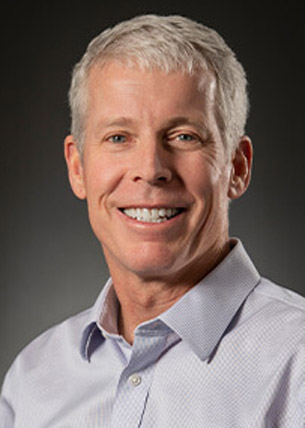
"We have finished that effort and we are keen to move forward with the majority of projects, which did pass [the review] either straight up or through restructuring."
Chris Wright, U.S. Secretary of Energy
Project Cypress is one of the first two regional DAC hubs selected under the DOE's $3.5 billion Regional Direct Air Capture Hubs program, established by the Bipartisan Infrastructure Law. The DOE has disbursed $50 million to project developers to date. The full $600 million grant potential is tied to a pay-for-performance structure requiring matching private sector investment.
The project had gone largely quiet since October 2024, as the Trump administration conducted its broad federal spending review. Project developers Climeworks, Heirloom Carbon Technologies, and Battelle kept public statements minimal during that period. The DOE's clearance now unlocks the path forward for one of the largest direct air capture projects in U.S. history.
>> RELATED: Direct Air Capture: The Technology Racing to Scale
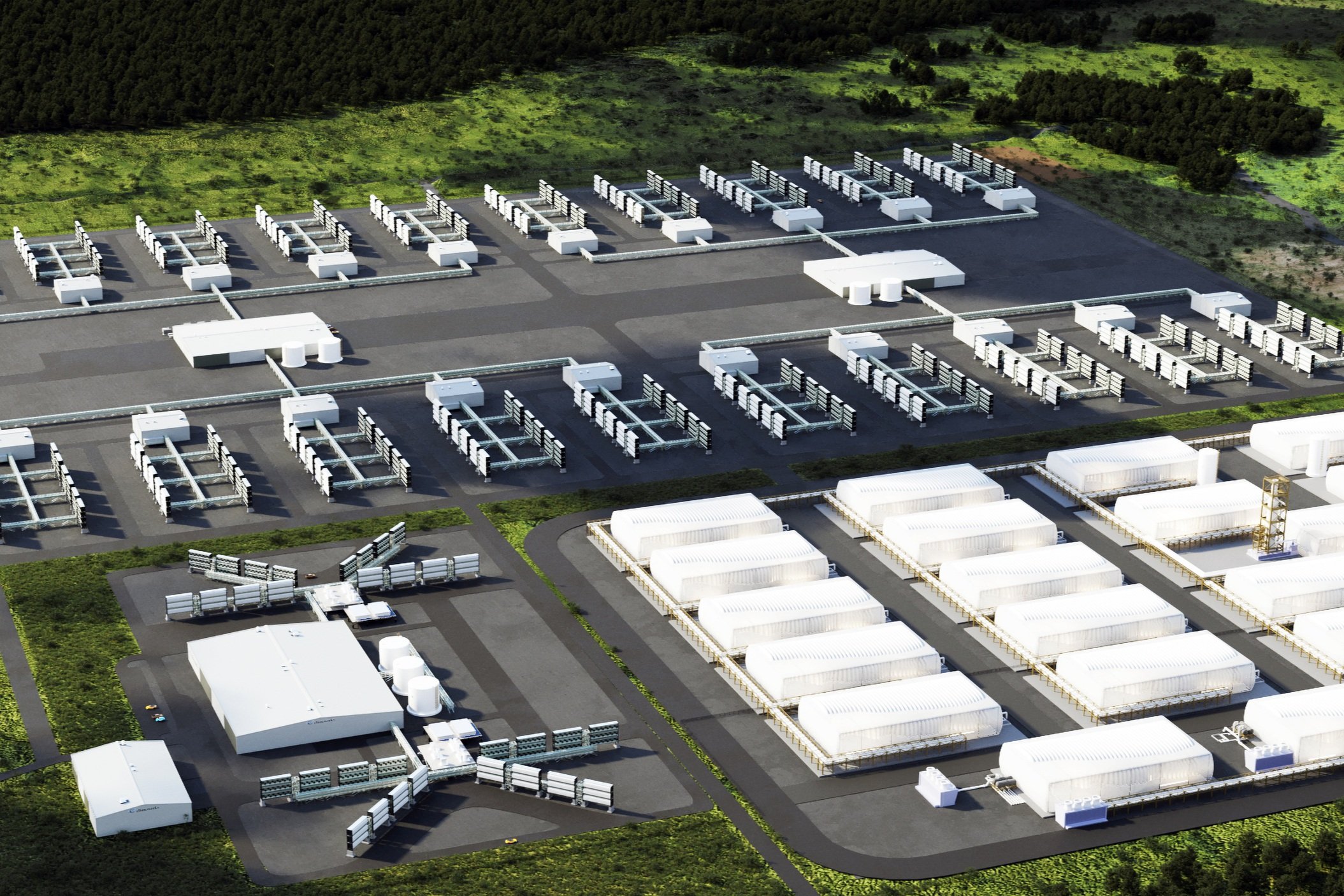
Who Are the Companies Building Project Cypress?
Project Cypress is led by Battelle, a Columbus, Ohio-based nonprofit research and development organization. Battelle serves as prime recipient of DOE funding and coordinates the full hub effort, bringing decades of experience in large-scale project management and carbon sequestration.
Two DAC technology companies serve as anchor providers, each deploying a distinct carbon removal approach at separate Louisiana sites.
Heirloom Carbon Technologies, a San Francisco-based company, will operate in northwest Louisiana at the Port of Caddo-Bossier in Caddo Parish. Heirloom's process heats limestone to produce calcium oxide. That material is then hydrated with water to form lime, which rapidly absorbs CO2 from the surrounding air. The process compresses what naturally takes years into less than three days. Heirloom's full Project Cypress contribution is designed to remove approximately 300,000 metric tons of CO2 per year at complete build-out.
Climeworks, a Zurich-based company and operator of the world's largest commercial DAC facility in Iceland, will build its Project Cypress facility near Vinton in Calcasieu Parish, southwest Louisiana. Climeworks' Generation 3 technology uses structured sorbent materials to trap CO2 as air flows through them. The materials release the gas when heated, and the CO2 is then stored underground. Validated at full scale in Switzerland from May 2024 to January 2025, Generation 3 captures more than twice as much CO2 per module and uses half the energy compared to the prior generation, according to Climeworks and confirmed by third-party testing partner Svante.
Together, the two facilities are designed to remove more than 1 million metric tons of CO2 from the atmosphere each year. That figure, 1 million metric tons annually, is the DOE's minimum threshold for a regional DAC hub under the Bipartisan Infrastructure Law. Project Cypress is targeting full operational capacity by approximately 2029.

How Will the Captured Carbon Be Stored?
Carbon storage is a critical component of Project Cypress, and Louisiana's geology makes it well suited for the task. The state is one of only six in the U.S. to hold regulatory primacy over Class VI injection wells, meaning state regulators, not federal agencies, oversee underground carbon storage permitting.
Carbon captured at Heirloom's northwest Louisiana facility will travel approximately 100 miles by pipeline to the CapturePoint Central Louisiana Regional Carbon Storage Hub, known as the CENLA Hub, located in Rapides and Vernon Parishes. CapturePoint is also the designated storage partner for Climeworks' southwest Louisiana facility, announced in October 2024. Captured CO2 from both sites will be permanently stored deep underground at the CENLA Hub, which CapturePoint describes as one of the largest onshore deep underground carbon storage centers under development in the United States.
For the southwest facility, CapturePoint will transport the captured CO2 to Class VI injection wells in Vernon and Rapides Parishes. The CENLA Hub advanced to Louisiana's short list for final Class VI permit evaluations in October 2025, a milestone covered on Decarbonfuse. CapturePoint's planned investment in the CENLA Hub exceeds $5 billion, with associated projects projected to generate up to $17 billion in new industrial activity if fully developed.
Gulf Coast Sequestration remains a key partner in the broader Project Cypress structure for storage in southwest Louisiana. Final permitting approvals are expected within 12 to 18 months, according to The Center Square.
>> RELATED: Heirloom and CapturePoint's Ambitious CO2 Sequestration Plans for Louisiana

Project Cypress is expected to generate more than 2,300 jobs and deliver billion-dollar economic impact, with Heirloom and Climeworks leading DAC deployment alongside regional workforce training partners in Louisiana.
What Jobs and Economic Benefits Will Project Cypress Create?
Project Cypress carries a significant economic footprint across both Louisiana sites. The job numbers differ by location and must be understood separately.
Heirloom's northwest Louisiana facilities at the Port of Caddo-Bossier are projected to create at least 1,000 construction jobs and more than 80 permanent positions. The State of Louisiana is offering $3 million in performance-based grants for Heirloom's sites, with up to $7 million in additional incentives available if payroll and employment targets are met over 10 years.
Climeworks' southwest Louisiana facility near Vinton is projected to create 140 direct permanent jobs and 800 construction jobs. Workers at the Climeworks facility will earn an average annual salary of $123,000, according to Louisiana Economic Development. The state also offered Climeworks an incentive package including LED FastStart workforce solutions, the Industrial Tax Exemption, and the Quality Jobs program.

"These investments not only bring meaningful economic activity and job creation to the region, but also help to cement Louisiana as a leader in this new energy economy and further America's leadership on the global stage."
Shashank Samala, CEO, Heirloom Carbon Technologies
Workforce development is built directly into the project structure. Developers have partnered with Bossier Parish Community College and SOWELA Technical Community College to design specialized training curriculum for the emerging carbon removal industry. The goal is to build local talent pipelines rather than import a workforce from outside the region.
Across both sites, Project Cypress is also projected to generate approximately 2,300 total quality jobs and produce a billion-dollar economic stimulus in the region, according to the Project Cypress team, including increased opportunities for local contractors, suppliers, and small businesses.
| Project Element | Detail |
|---|---|
| Total DOE funding eligible | Up to $600 million |
| Initial disbursement | $50 million (already released, March 2024) |
| Annual CO2 removal target | 1 million metric tons at full operation |
| Northwest facility (Heirloom) | Port of Caddo-Bossier, Caddo Parish; ~300,000 MT/year capacity |
| Southwest facility (Climeworks) | Calcasieu Parish near Vinton; first stage ~300,000 MT/year |
| Primary storage partner (both sites) | CapturePoint CENLA Hub, Vernon and Rapides Parishes |
| Heirloom construction jobs | At least 1,000 |
| Heirloom permanent jobs | More than 80 |
| Climeworks construction jobs | 800 |
| Climeworks permanent jobs | 140 direct jobs, average $123,000/year salary |
| Climeworks FID and construction start | Q3 2026 (per Louisiana Economic Development, October 2024) |
| Heirloom Phase 1 operational target | 2027 (100,000 MT/year initial capacity) |
| Full hub operational target | Approximately 2029 |
Why Is Louisiana the Right Place for This Hub?
Louisiana brings a rare combination of assets to DAC development. Its geology, particularly the porous sandstone and dolostone formations found across central and southwest Louisiana, is well suited to permanent underground CO2 storage. The state's Class VI primacy speeds up permitting compared to states still relying on federal EPA approval.
The state also has a deep industrial workforce with transferable skills from oil and gas, petrochemicals, and pipeline operations. Project Cypress is explicitly designed to tap that existing talent pool. Both Heirloom and Climeworks have pointed to Louisiana's industrial history as a primary reason for siting their facilities there.
Louisiana's infrastructure adds further advantages. Existing pipeline networks, port facilities at Caddo-Bossier and Vinton, and proximity to major CO2 storage formations reduce capital requirements. This is part of why Louisiana has attracted not just Project Cypress but a growing cluster of carbon storage projects tied to the CENLA Hub, including agreements with Energy Transfer and Southwestern Energy to capture CO2 from Haynesville natural gas operations.
The federal 45Q tax credit is also a factor. Project Cypress partners intend to claim the $180-per-ton credit for DAC with geological storage once facilities are operational. That credit survived recent policy changes and covers a meaningful share of per-ton removal costs during the scale-up phase, helping make the economics work at this stage of the industry.
>> RELATED: How Direct Air Capture Could Drop 75% in Cost
What Comes Next for Project Cypress?
The DOE's audit clearance removes the largest single obstacle Project Cypress has faced since the Trump administration began its spending review in May 2025. Several steps remain before carbon begins flowing underground at scale.
The CENLA Hub is advancing through Louisiana's final Class VI permit evaluation process. Final well approvals for southwest Louisiana storage are expected within 12 to 18 months, according to The Center Square.
Climeworks is targeting a final investment decision and construction start in Q3 2026, with operations at its Calcasieu Parish facility expected by the end of 2027, per Louisiana Economic Development. The project will use the company's Generation 3 technology, validated at full scale across more than 1,300 performance cycles in Switzerland between May 2024 and January 2025.
Heirloom's Phase 1 at the Port of Caddo-Bossier is designed to remove 100,000 metric tons of CO2 per year. It is targeted to be operational in 2027. Subsequent phases will triple that capacity to the full 300,000 metric tons per year, subject to additional funding and hub program reviews.
The project also requires a finalized Community Benefits Plan before unlocking the full $600 million. That plan must be a legally binding framework documenting measurable local benefits. Developers have already partnered with Bossier Parish Community College and SOWELA Technical Community College on curriculum development, and have established a Community Engagement Council framework for both sites.
The $3.5 billion DOE DAC Hubs program funds up to four hubs across the U.S., each capable of removing at least 1 million metric tons of CO2 annually. Project Cypress and the South Texas DAC Hub, led by Occidental Petroleum's subsidiary 1PointFive, were the first two selected in August 2023. Both projects clearing the federal audit reflects continued support for scaling carbon removal in the United States.
>> RELATED: The Companies Leading the Charge in Direct Air Capture
Louisiana's Carbon Removal Future Starts Here
Project Cypress represents the largest public investment in carbon removal in U.S. history, with up to $600 million in federal grants available to a project targeting 1 million metric tons of atmospheric CO2 removed each year at full capacity. That 1-million-metric-ton benchmark is the same scale the DOE set as its minimum for the regional hub program from the start.
The DOE audit clearance confirms the project's business viability in the eyes of the current administration. With Heirloom and Climeworks moving forward at their respective Louisiana sites, Battelle coordinating the overall effort, and CapturePoint advancing CENLA Hub permitting, the pieces are falling into place.
Louisiana is not just a location on a map. It is a state with the geology, the regulatory authority, the industrial workforce, and the infrastructure to make commercial-scale carbon removal work at cost and pace. The next two to three years will test whether Project Cypress can convert that advantage into operational reality, and whether the U.S. can hold its lead in the global race to remove carbon from the atmosphere.
Frequently Asked Questions
What is Project Cypress?Project Cypress is a regional direct air capture (DAC) hub in Louisiana, led by Battelle with technology partners Climeworks and Heirloom Carbon Technologies. It is funded in part by the U.S. Department of Energy under the Bipartisan Infrastructure Law's $3.5 billion Regional DAC Hubs program. The hub is designed to remove 1 million metric tons of CO2 from the atmosphere each year at full operation.
How much federal funding does Project Cypress qualify for?
Project Cypress is eligible for up to $600 million in federal grants. The funding is tied to a pay-for-performance structure requiring matching private sector investment. The DOE released the initial $50 million tranche in March 2024.When will Project Cypress be fully operational?
Full operation is targeted for approximately 2029. Heirloom's Phase 1 in northwest Louisiana is expected to begin operations in 2027 with an initial 100,000 metric ton per year capacity. Climeworks is targeting operations at its southwest Louisiana facility by the end of 2027, with a final investment decision and construction start planned for Q3 2026.
Subscribe to the newsletter
Daily decarbonization data and news delivered to your inbox
Follow the money flow of climate, technology, and energy investments to uncover new opportunities and jobs.
Latest issues
-
113 CCS Projects: What's Driving the Surge?
Inside This Issue 🏭 Global CCS Hits 113 Projects as Americas Lead Capacity 💰 We're Moving $2M+ to Climate Solutions 💧 China Launches World's First Semi-submersible Offshore Wind-to-hydrogen Platfo...
-
Why Is Wyoming Giving 650,000 Acres to Carbon Storage?
Inside This Issue 🪨 Inside Blm's 650,000-Acre Bet on Wyoming Carbon Storage 🏭 California Advances Carbon Capture and Removal Regulations Under SB 905 ⚡ Why a Japanese Power Giant Is Betting on Den...
-
Colorado Joins the 7-State CCS Permit Fast Lane
Inside This Issue ⚖️ Colorado Takes Over Class VI Permits: What Changes for CCS? 🏭 Hebei Shoulang Facility Using LanzaTech Technology Achieves World’s First ISCC EU RCF Certification for Ethanol P...
Company Announcements
-
A consortium led by Novacium, together with Axel’One and AD-VENTA, has secured funding from the Defence Innovation Agency (AID) and the Directorate General of Armaments (DGA) under the RAPID progr...
-
Video: The Next Chapter https://youtu.be/LUIHqS35rMg Led by John Douglas, whose development experience includes the $8 billion Champlain Hudson Power Express, the collaboration brings major Nort...
-
Emvolon Raises $22 Million Funding Round to Launch Its Modular, Waste-to-Fuel Chemical Plants
Following its recent offtake agreement and increased commercial demand, Emvolon raises Series A and non-dilutive federal and state grants to launch first commercial system and adds industry growth ...
-
Puro.earth Expands DACCS Certification With CCS+ Methodologies
Puro.earth has published its CCS+ methodology documents, with direct air capture and geological storage (DACCS) as the first activity type implemented under its CCS+ Program. Puro.earth’s multi-pr...